
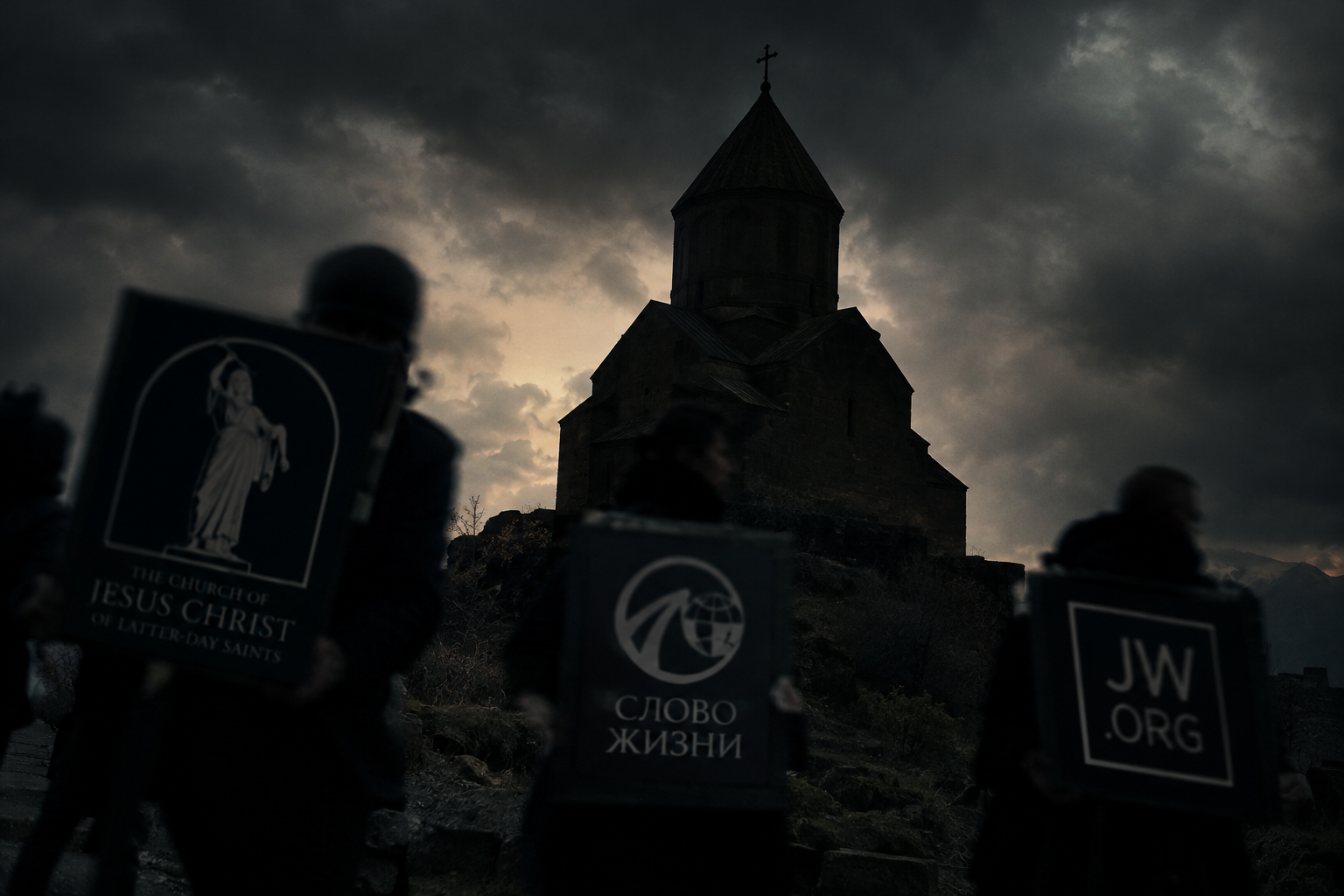
SECRET CHURCH: HOW SECTARIAN ORGANIZATIONS ARE TURNING ARMENIA INTO A FOOTHOLD FOR FOREIGN INFLUENCE
From American missionary organizations and Word of Life to Nikol Pashinyan’s inner circle: ANI’s investigation into foreign religious structures, political mobilization, and the conflict unfolding around the Armenian Apostolic Church.
The 1988 Earthquake: The Beginning of a New Era
After the devastating Spitak earthquake of December 7, 1988, Armenia found itself in a humanitarian disaster. Destroyed infrastructure, thousands of victims, the multitude of people deprived of housing, and the social vulnerability of the population created favorable conditions for the activities of foreign religious organizations. Humanitarian aid gradually became one of the ways for them to establish themselves in the country.
According to a study by Renata Król-Mazur, a researcher at Jagiellonian University in Kraków, entitled “Religious Sects as a Threat to Social Security in the Republic of Armenia,” American businessman and representative of the Church of Jesus Christ of Latter-day Saints John Huntsman provided Armenia with $18 million in aid. In 1990, he founded the Huntsman Building Products company in Yerevan, and in 1992, the religious organization received official registration in Armenia.
In September 1993, the State Historical Archives of Armenia began cooperating with the Family History Library associated with the Mormon Church. Archival documents, including Armenian metric and parish registers concerning baptisms, marriages, and burials, were microfilmed and transferred to the genealogical library in Salt Lake City. In 1998, the archive’s director, Sonya Mirzoyan, compiled a list of the relevant materials in Armenian and Russian. Later, these collections were included in the FamilySearch catalog.
In March 2012, the Ministry of Diaspora, under Hranush Hakobyan’s leadership, launched the “Virtual Museum of the Armenian Diaspora,” one of whose sections was devoted to Armenian genealogy. Six million drams were allocated from the state budget for the creation of the website and the expansion of its content. Thus, international religious networks gained access to infrastructure connected not only with missionary activity but also with historical and genealogical data on Armenians.
As a result, humanitarian aid and archival programs have turned into means of long-term entrenchment and the accumulation of influence, whose scope is much broader than the purely religious sphere.
Word of Life: From Religious Communities to the Prime Minister’s Political Circle
One of Armenia’s most influential Protestant organizations has become Word of Life, led by pastors Arthur and Lusine Simonyan. According to the church’s own data, Arthur Simonyan has led the Armenian community since 1995, and the organization has established dozens of communities in Armenia and abroad. One of its key leaders is Armen Lusyan, who is presented in an analytical report by the Institute of Europe of the Russian Academy of Sciences as the second pastor of the Yerevan church.
The organization has a broad range of tools for attracting young people: concerts, summer camps, youth meetings, home groups, and educational programs. Since 2014, the Zoom project has been operating, targeting young people in rural settlements. Such methods serve as a mechanism for developing a lasting dependence on the religious community, while the church presents them as missionary and educational activities.
Particular attention should be paid to Word of Life’s political activity in the spring of 2018. Roman Lunkin’s 2018 study, “The Position of Protestant Churches During Armenia’s Political Crisis,” published by the Institute of Europe of the Russian Academy of Sciences, states that on April 23, the church organized an event called “Prayer for Armenia.” Arthur Simonyan publicly supported the demand for change, spoke about the peaceful nature of the protests and the need to fight corruption. According to the researcher’s assessment, representatives of Word of Life and other Protestant communities participated in civic actions, while the total number of activists from these associations was estimated at 3,000–5,000 people.
After the change of power, personnel connections between the church and the Prime Minister’s Office emerged.
On July 10, 2018, Armenian media reported that Gevorg Achemyan, who held the position of Head of Administration at the Prime Minister’s Office, belonged to the Word of Life sectarian community. In an interview with 168.am, Achemyan confirmed: “I am a follower of that denomination, I am from the Word of Life church, this is my faith.”
In September 2018, Sofya Navasardyan, who had previously been the stylist of the Prime Minister and Anna Hakobyan, became Nikol Pashinyan’s assistant. Later, Armenian media, referring to publications on social networks, reported on her connection with the religious organization.
Another episode concerns July 6, 2018, when the “New Armenia, New Catholicos” movement came out against Catholicos of All Armenians Karekin II, demanding his resignation. According to Armenian media, the movement was financed by Vahe Petrosyan, head of the non-governmental organization “League for the Protection of Motorists” and an associate of Gevorg Achemyan. The media also reported that Petrosyan was a member of the Word of Life sectarian church.
Thus, the Word of Life sectarian organization has evolved from a religious structure into a noticeable factor in the Prime Minister’s political circle. The question of the limits of its influence now concerns a broader problem: the fusion of sectarian networks and state power.
Jehovah’s Witnesses: International Leadership and Armenian Laws
Another major player in Armenia’s religious landscape is the organization Jehovah’s Witnesses, whose international governing body is located in Warwick, New York State, USA. According to the organization’s own data, there are 125 congregations operating in Armenia, and the number of publishers reaches 11,779.
The chairman of the council of the religious organization in Armenia is Hrach Keshishyan, and his deputy is lawyer Levon Margaryan. The central office is located at 38 Keri Street in Yerevan. Registered centers exist in Kapan, Gyumri, Armavir, Vanadzor, Hrazdan, Masis, Ararat, Artashat, and other cities.
The main contradiction with the state arose around the issue of military service. On July 7, 2011, the Grand Chamber of the European Court of Human Rights recognized a violation of the right to freedom of conscience in the case of “Bayatyan v. Armenia.” Vahan Bayatyan, who had refused military service in 2001 on religious grounds, had previously been sentenced to two and a half years of imprisonment. The ECHR ruled that he should be paid €10,000 in compensation for non-pecuniary damage and a further €10,000 for legal costs.
In 2013, Armenia reformed its alternative service system. However, as reported in Forum 18 materials, representatives of other denominations continued to encounter refusals. In particular, Baptist Davit Nazaretyan, who submitted an application in January 2023, received a refusal and was sentenced to two years of imprisonment in October of the same year. According to commission member Vardan Astatsatryan, among the 15–20 people who applied in 2024, applications by representatives of Jehovah’s Witnesses were approved.
The financial scale of the organization’s activities has also attracted media attention. In August 2026, it rented the large hall of the Karen Demirchyan Sports and Concert Complex in Yerevan to hold conventions. The complex’s director, Karen Ghazaryan, told NEWS.am that 200 million drams, approximately $553,000, had been paid to rent the hall on Fridays, Saturdays, and Sundays throughout the month.
In November 2025, Panorama.am published an article about Teresa Avetisyan, who participated in Nikol Pashinyan’s religious events and spoke against Catholicos Karekin II. The media outlet presented her as a member of Jehovah’s Witnesses.
Thus, in Armenia, Jehovah’s Witnesses constitute a centralized structure that, following the 2013 reform of alternative service, has in practice received privileged access to this system, while representatives of other denominations continue to face refusals and criminal prosecution. The organization’s financial capabilities and alleged connections with Pashinyan’s circle indicate that its activities extend beyond the purely religious sphere and require assessment from the perspective of national security and equality before the law.
How Are Followers Recruited? The Study on 98 Percent
The most important section of the investigation concerns not sensational statements about “zombification,” but the actual methods used to attract followers.
In his doctoral dissertation, “Jehovah’s Witnesses in Post-Soviet Armenia,” defended at the University of California, Los Angeles, in 2023, American sociologist Anatoly Tokmantsev studied Jehovah’s Witness communities in Armenia. Between 2016 and 2022, he conducted field research, speaking with the organization’s followers, officials, journalists, activists, and representatives of the Armenian Apostolic Church.
According to his materials, in 98 percent of first-contact cases, contact was established through personal acquaintances, with relatives, friends, colleagues, or neighbors acting as intermediaries. Random encounters on the street played a much smaller role.
This conclusion is consistent with the study “Networks of Faith: Interpersonal Bonds and Recruitment to Cults and Sects,” published in the American Journal of Sociology in 1980 by sociologists Rodney Stark and William Bainbridge. The authors emphasized the importance of interpersonal connections in the spread of religious movements.
A similar approach is described in official missionary manuals. Jehovah’s Witnesses’ guide Improving Our Skills in the Ministry — Making a Return Visit recommends returning to a person who has shown interest, taking their interests into account, and consistently developing the interaction until Bible study begins. The Mormon Church’s manual Preach My Gospel also recommends asking members of an existing community for suggestions on contacting new people and establishing acquaintances through friends and relatives.
Thus, the mechanism for expanding religious networks is based on repeated interactions, trust, and drawing a person into a new social environment. What is essential to the investigation is another circumstance: such a system allows organizations to form stable communities that can quickly unite and mobilize to participate in political processes.
“Embassy of God” and the Ukrainian Experience
An illustrative example of religious mobilization is the Embassy of God church, founded in Kyiv in 1994 by Nigerian preacher Sunday Adelaja.
On his official website, Adelaja described the organization’s participation in Ukraine’s 2004 “Orange Revolution.” According to him, the church recruited 1,500 people to work in electoral commissions, ensured the participation of 4,000 volunteer observers, distributed more than 500,000 leaflets, and mobilized believers to participate in demonstrations supporting Viktor Yushchenko.
Leonid Chernovetsky, who was later elected mayor of Kyiv, was also among the church’s well-known followers. The Ukrainian example shows how a religious organization can use its own infrastructure for large-scale political mobilization.
In Armenia, a movement associated with this charismatic environment is represented by the Living Faith church, led by senior pastor Khachik Safaryan. Eva Lashchenova’s article “Armenia on the US Chessboard,” published in the journal World Economy and International Relations in 2006, mentioned the Living Faith church, which was presented as a branch organization of Ukraine’s Embassy of God church.
In January 2013, Alexander Amaryan, head of the Center for Assistance and Rehabilitation of Victims of Destructive Cults, also mentioned Living Faith among the charismatic movements that concerned him. In an interview given in 2020, he drew particular attention to the electoral potential of religious communities: a pastor who enjoys authority among followers can influence the political behavior of a significant portion of his audience.
Religious Diplomacy and Conflict with the Armenian Church
The contradiction manifests itself most sharply in a situation where the state authorities are simultaneously expanding ties with foreign religious structures and entering into conflict with the Armenian Apostolic Church.
In May 2025, the confrontation between the government and the AAC entered a new phase. High-ranking clergymen were arrested, and the issue of Catholicos Karekin II’s resignation became part of the political agenda. Prime Minister Nikol Pashinyan and a group consisting of ten bishops signed a framework document on the “renewal” of the church.
On August 24, 2026, Pashinyan declared that there was a “deep systemic crisis” in the AAC. On September 24, the Public Relations and Information Center of the Prime Minister’s Office published a report prepared on his instructions. The document listed circumstances that its authors linked to the crisis: financial opacity, personnel policy, the politicization of church activities, and foreign influence. The Mother See of Holy Etchmiadzin called the report “unconstitutional, uncanonical, and illegal,” assessing it as state interference in the internal life of the church.
Another important event was the international religious platform Armenia Prayer Breakfast, held in Yerevan on October 2–3, 2026. Representatives of state bodies, diplomatic circles, the business community, and religious organizations from Armenia and other countries participated. Pashinyan met with Asif Mahmood, chairman of the US Commission on International Religious Freedom, who had arrived for the event, and announced prospects for long-term dialogue and practical cooperation.
At the same time, Armenia’s ambassador to the United States, Narek Mkrtchyan, developed ties with foreign religious structures. As 168.am noted, in September 2025 he met with Matt Potter, co-founder of Pray.com, and also held meetings with representatives of the Church of Jesus Christ of Latter-day Saints and other religious organizations.
Against this background, a logical question arises: why is international religious cooperation viewed by the authorities as a resource for democracy and diplomacy, while the national historical church has become a target of state interference?
The Investigation’s Conclusions
Thus, the totality of the collected facts—from humanitarian programs implemented after the 1988 earthquake and archival agreements with Mormon genealogical structures to direct penetration into the Prime Minister’s Office and the privileged opportunities for Jehovah’s Witnesses to use the alternative service system—makes it possible to view the activities of transnational religious networks in Armenia not as a matter of freedom of conscience, but as a system for the deliberate weakening of the nation-state.
The opposing positions of the Armenian and Azerbaijani branches of Word of Life during the 2020 war, the consultation held by that network’s international council in Istanbul in May 2024, and the financial power of Jehovah’s Witnesses, expressed in the rental of the country’s largest halls for hundreds of millions of drams, show that these structures operate according to the logic of external geopolitical interests, far removed from national interests.
Against the backdrop of persistent attacks on the Armenian Apostolic Church—the arrests of archbishops, the government report on a “systemic crisis,” and the “New Armenia, New Catholicos” movement—sectarian organizations act not merely as a parallel force, but also as a tool for replacing traditional spiritual identity with a controllable identity.
If every tenth citizen is involved in a network whose centers are located across the ocean, if manuals for recruiting followers repeat almost word for word the methodological guidelines of special services, and if religious activists appear in the Prime Minister’s closest circle, then this is a matter of the silent occupation of public consciousness. Its ultimate goal is to deprive Armenia of the ability to act independently, divide the Diaspora, and dissolve national identity.
That is precisely why the issue of sects is no longer purely religious. It is a question of national security and the survival of Armenian statehood.