
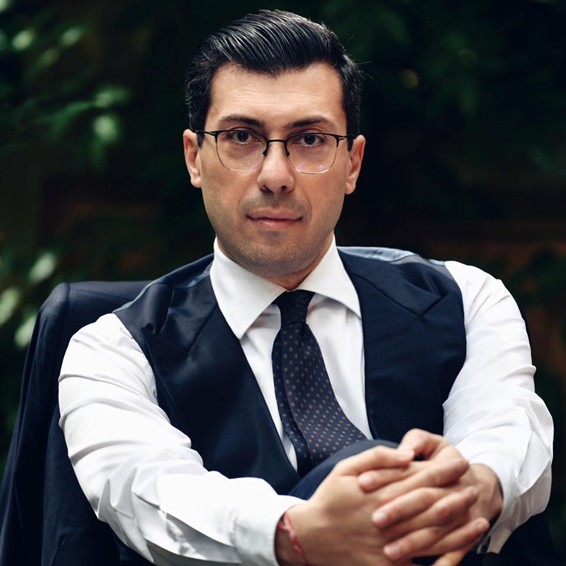
THE “GREY CARDINAL” WHO REMAINED “MISHIK”
Mikael Minasyan is one of the most influential and, at the same time, most controversial figures in Armenia’s political and economic life over the past two decades. Serzh Sargsyan’s son-in-law, first deputy head of his presidential administration, and later Armenia’s ambassador to the Holy See, Minasyan also remained at the center of attention of the Armenian press and investigators for many years — in connection with various stories involving the media market, energy, the mining industry, and the hotel business.
Minasyan’s name in the political and public sphere was accompanied by the nickname “Mishik,” and a reputation as a “grey cardinal” developed around him — a figure operating outside official power structures but possessing extensive opportunities to influence decision-making, as well as far-reaching connections and levers of influence. This image was based on numerous episodes accumulated over the years: proximity to the highest levels of power, stories surrounding major economic assets, and the ability to use the media as an instrument of political influence.
This investigation by ANI is devoted to Minasyan’s economic and political projects, schemes that became the subject of investigations, and the role he played in preparing and carrying out the political events of 2018.
Early Years, Proximity to Power, and the Diplomatic “Pause”
Minasyan received a European education: from 1993 to 1996, he studied at the Murad-Raphaelian Armenian College in Venice, then until 2000 at the relevant faculty of the University of Trieste, specializing in international relations and diplomacy. From 2001 to 2004, he pursued postgraduate studies at the Institute of History of the National Academy of Sciences of Armenia.
European connections — working in the office of a Member of the European Parliament and directing a diplomat-training program — became important prerequisites for his international career. However, Minasyan’s political path in Armenia took on a much more concrete direction, tying him to Serzh Sargsyan.
He first served as Sargsyan’s assistant, and in 2008 became First Deputy Head of the Presidential Administration. During the same period, Minasyan also entered the president’s immediate family circle: he is married to Serzh Sargsyan’s eldest daughter, Anush.
In November 2011, he officially left the Presidential Administration. However, leaving the center of power did not mean leaving political life. Minasyan moved to the Republican Party’s election headquarters and coordinated the 2012–2013 election campaigns.
After the 2013 presidential election, Serzh Sargsyan sent his son-in-law into diplomatic service. On March 9, 2013, Minasyan was appointed Armenia’s ambassador to the Holy See. Later, the position was supplemented by the duties of ambassador to the Sovereign Order of Malta, starting December 10, 2013, and to Portugal, starting in May 2016.
In the eyes of observers, this appointment had a dual significance: on the one hand, an elevation of diplomatic status; on the other, an opportunity to remove, to a certain extent, one of the most controversial representatives of the president’s family circle from the domestic political scene.
But political influence is not measured in kilometers. Being in Rome or Lisbon did not mean that Minasyan had lost the ability to influence Armenia’s domestic political and economic processes. Various accounts and publications continued to link him to media resources and business interests.
The Media as a Political Weapon
One of the important pillars of Minasyan’s influence was the media system that formed around PanArmenian Media Group and operated approximately from 2012 to 2019.
The holding included Armenia TV, ArmNews, ATV, PanArmenian TV, Tert.am, BlogNews.am, Radio Jan, and Lav Radio.
According to documents, the owners were various individuals and companies — Artur Janibekyan, as well as companies registered in the United States or offshore jurisdictions. However, journalistic investigations and published chains of connections pointed to Mikael Minasyan’s links with all these entities.
Press Stand, a press distribution company that owned hundreds of kiosks, provided the entire distribution logistics for printed publications. Thus, another infrastructure of influence was formed, which was used to control and affect the information landscape.
The media here was not just a business. It was a political instrument.
It made it possible to shape public images every day, to “switch on” one person in the political arena and “switch off” another, to change the emphasis of the agenda at the right moment and shift public attention wherever it was required.
In 2019, after the change of power, the holding “fell apart”: the assets were distributed among various owners, and some media resources were restructured. However, the network of personal connections did not disappear.
Business Empire and the Mechanism of Repeated Transactions
A number of major privatizations and transactions related to energy, mining, telecommunications, and the hotel sector became the focus of criminal investigations and journalistic inquiries.
In various cases, almost the same mechanism was repeated: a state asset was sold through newly established or registered companies, often involving offshore entities. The transaction price was documentarily understated, or the operation was presented as fictitious lending arrangements. Regulatory conditions were then changed — preferential tariffs, criteria for classifying small hydroelectric power plants, and other rules — resulting in excessive profits. The ultimate beneficiaries remained hidden behind nominal owners.
The following are examples frequently mentioned in investigative materials and journalistic publications.
Dzoraget Hydroelectric Power Plant
On December 16, 2010, the government approved the sale of the Dzoraget Hydro company complex for 3.6 billion drams.
Before the sale, the station’s electricity tariff was sharply revised. Publications first reported a reduction, and then — after the capacity threshold for small hydroelectric power plants was raised from 10 to 30 MW in 2011 — the station’s transfer into a preferential category.
According to the prosecution, the owners received preferential tariffs and significant additional income. The Prosecutor’s Office points to cases in which shares were fictitiously registered through trusted individuals, as well as transfers of funds to foreign accounts. The investigation estimates the dividends attributable to shares registered through associates at hundreds of millions of drams.
Criminal proceedings concerning this episode were initiated in 2019. In 2024–2025, the cases were separated into individual proceedings, and investigations involving a number of people continued in absentia.
Vorotan Cascade
The sale of the cascade, which generated a significant share of the country’s electricity, was formalized on January 29, 2014, with the company ContourGlobal Hydro Cascade for $180 million.
The offshore trail, entities registered in Luxembourg and Delaware jurisdictions, the low registered charter capital of the purchasing company in Armenia, and suspicions regarding the actual arrival of foreign funds became grounds for numerous public questions and investigations.
According to some publications, the buyer’s office in Yerevan was located in premises associated with Minasyan’s circle. Other publications pointed to a complex chain of banking transactions and pledges.
Zangezur Copper-Molybdenum Combine (ZCMC)
The chain of ownership changes involved Cypriot and Dubai-based companies, as well as large loans.
In July 2018, the Cypriot company Walnort acquired the company Moon Metals for $2,009,988. Moon Metals owned 12.5 percent of ZCMC. Subsequently, the Prosecutor’s Office stated that there had been schemes under which large loans were repaid directly using the combine’s funds, while actual control over the shares was established through interconnected entities.
Shant and Other Assets
Shant television company, Noratus radio station, agricultural products exporter Spike, Ucom, Yerevan Mall, the DoubleTree and Opera Suite hotels, Renco projects in Florence, and the Jazzve café chain.
In all these cases, investigators and journalists recorded connections between individuals and companies, offshore owners, nominal shareholders, and large money transfers.
Jazzve is one of the rare examples in which Minasyan’s participation is documented. According to the register, from 2003 to 2011 he was the company’s sole shareholder, after which the shares passed to Jazzve Holding (BVI), and in 2018, according to registry data, the owners became Artur Janibekyan and other individuals.
The same names repeatedly appear in these stories — Leonid Arevshatyan, whom publications linked to the management of some of Minasyan’s businesses; Armen Petrosyan; Artur Janibekyan; and Tigran Egoyan.
For investigators, they are part of a network of trusted individuals and nominal owners. For the defense, they are independent entrepreneurs.
The Computer, Arrests, and 76 Counts of Accusation
One of the most important sources of the investigative materials is a computer used by Minasyan from 2009 to 2014.
The materials mention approximately 9,000 files — correspondence, contracts, bank statements, and tax documents. According to the Prosecutor’s Office, this computer represents a kind of “map” of connections between companies, intermediaries, and government officials.
In the spring of 2020, interim measures began to be imposed on a number of companies — Jazzve, Office Class, Dzoraget Hydro, Spyka, PanArmenian Media Group, Armenia TV, and others: restrictions on transactions were introduced and shares were placed under arrest.
On August 6, 2024, the Prosecutor’s Office initiated public criminal prosecution against Minasyan on 76 counts, classified under 13 articles of the Criminal Code — ranging from the unlawful participation of an official in entrepreneurial activity to money laundering and the creation of a criminal organization.
The alleged damage caused to the state is estimated at hundreds of millions of dollars.
In some cases, proceedings were separated and sent to court, while proceedings against Minasyan are being conducted in absentia in several instances.
In July 2022, Interpol suspended the international search for Minasyan.
The Political Dimension: “Cultivating” the Opposition and 2018
The most controversial and widely discussed aspect of Minasyan’s biography is his political role.
What matters here is not only individual transactions. It is far more important to understand how economic and media resources could have served to shape the political landscape.
Two key directions stand out here.
First — Longstanding Acquaintances in Pashinyan’s Team
People who later found themselves in Nikol Pashinyan’s inner circle had been connected to Minasyan in certain instances long before 2018.
For example, the story of the disappearance of 19 valuable books from the Genocide Institute-Museum in 2004. The case, opened only in 2007, was presented in publications as a connecting link between young researchers and postgraduate students. Ararat Mirzoyan and Vladimir Vardanyan were mentioned in this context. Both later became members of Pashinyan’s Civil Contract party.
Political biographies provide grounds for assuming that personal contacts and longstanding professional connections may have become channels of communication that persisted even after the change of power.
Second — Financing Haykakan Zhamanak and the “Controlled Opposition”
Minasyan publicly stated that for many years he bought up unsold copies of Nikol Pashinyan’s newspaper in order to stop the “slander” being spread about his family.
However, within the logic of Armenian political reality in 2008–2018, this story raises many questions. During that period, the law enforcement and oversight institutions were under the control of the former elite. Therefore, the version that publications could have criticized Minasyan for years without any consequences does not seem particularly convincing.
This gives rise to another interpretation: financing the newspaper may not have been a reaction in response, but rather a strategic investment in creating a recognizable, “people’s” opposition leader who could become a convenient figure at the moment when a necessary restructuring of power took place.
In practice, this meant opposition kept within acceptable limits — an opposition platform capable of criticizing the authorities but not threatening the foundations of the power system.
The result of this strategy became apparent in 2017.
The Yelk Alliance, which also included Pashinyan’s structures, entered parliament, receiving 7.79 percent and 9 seats. This was enough for the status of legitimate opposition, but not enough to seize power.
Under conditions of control over the electoral system, when Central Electoral Commission head Tigran Mukuchyan was perceived as a person loyal to the former authorities, the opposition’s “modest” results could have been deliberately ensured as a political fallback option.
This version receives additional support from the fact that, after the election, Yelk publicly declared that there had been violations but ultimately did not challenge the results. For the logic of a “controlled opposition,” such behavior was quite convenient.
Kolerov and “Minasyan’s Prediction”
In the context of the theory of a “controlled transfer of power,” the testimony of Russian political scientist Modest Kolerov deserves particular attention.
According to Kolerov, several years before Pashinyan came to power, he spoke with Minasyan in Yerevan. Minasyan then confidently stated:
“This party will win a majority in the next election.”
At that time, My Step had barely 8 percent of the seats in parliament and did not look like a contender for victory at all.
Kolerov asked, “Why do you need this?” and, according to him, received a sobering answer: “Well, that’s how it is.”
If Kolerov’s account is credible, then we are dealing with a remarkable circumstance: according to this testimony, Minasyan possessed not only information but also confidence in the final outcome of the political game at a time when that outcome was by no means obvious.
This episode becomes one of the important pillars of the theory that 2018 was, to a certain extent, a scenario prepared by the elites to change the political structure under controlled conditions.
Access to Secret Materials and Public Leaks
After the change of power, Minasyan openly found himself in the opposition camp.
He published video addresses and circulated documents, including Ararat Mirzoyan’s handwritten statement about cooperation with the National Security Service, a letter dated September 1, 2020, from CSTO Secretary General S. Zas to the Secretary of Armenia’s Security Council, as well as excerpts from a conversation between Putin and Merkel dated December 7, 2020.
Minasyan claimed that he possessed a large body of classified information, some of which he did not use for security reasons.
The publications prompted prosecutorial checks and disputes over the authenticity and content of the documents. At the same time, they showed that Minasyan had access to materials circulating in diplomatic and law enforcement circles.
Two Working Theories and the Meaning of What Is Happening
Taken together, the facts — economic schemes, long-term media investments, interconnected networks, and Kolerov’s testimony — give rise to two working theories.
- The theory of a broken agreement. It is possible that the 2018 “Velvet Revolution” was based on behind-the-scenes agreements on the transfer of power that were subsequently violated. Within this logic, the absence of actual criminal prosecution of Serzh Sargsyan is not an expression of democracy, but a forced measure by Pashinyan to protect the former president from possible revelations.
- The theory of a “controlled farce.” Judicial activity may serve as a smokescreen concealing the real nature of the connections between the old elite and the new authorities. The very fact that Interpol discontinued the search for Minasyan confirms that, had there been genuine political will on Yerevan’s part, the results would have been different.
Within this paradigm, some prosecutions are staged, while others are real; however, their ultimate course is determined not only by legal arguments but also by political expediency.
Conclusion
This entire story allows us to assume that what we are witnessing is not the cleansing of the system, but its controlled transformation. It cannot be ruled out that the political processes currently taking place in Armenia are a prelude to a transfer of power back in the opposite direction. This may happen after Nikol Pashinyan completes his main historical mission — the final ousting of Russia from the South Caucasus. Artsakh and Armenia’s sovereignty have already become victims of this strategy, while the current “fight against corruption” serves merely as an instrument for preparing the ground for the redistribution of assets and a new alignment of elites, in which the old players will once again be able to find their place.
Ultimately, the story of Mikael Minasyan is the story of a man who reached the pinnacle of power but never occupied it, remaining in political memory as “Mishik.” His figure continues to serve as a convenient indicator: if the current judicial system fails to bring the case to its logical conclusion, this will mean that the fight against “grey cardinals” is merely part of a much larger mystification hidden from the public.