
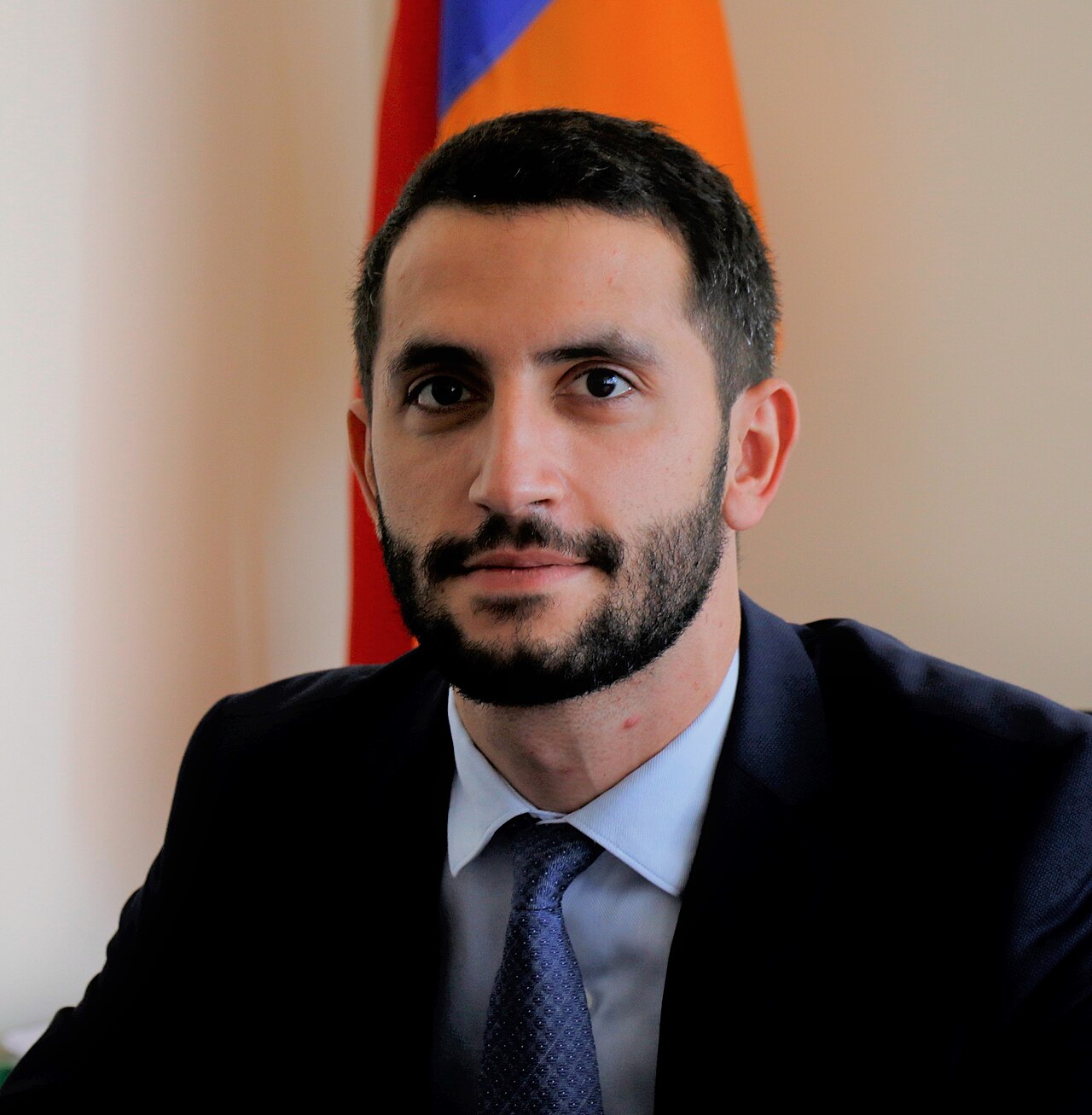
RUBEN RUBINYAN: THE RISE OF HIS CAREER, THE TURKISH DIRECTION, AND THE PRICE OF “NORMALIZATION”
In any normal country, becoming the chief negotiator on one of the most sensitive directions of foreign policy is the pinnacle of a professional career. Diplomats who have worked in international institutions for decades, participated in the most difficult negotiations, and demonstrated their ability to defend state interests are appointed to such positions.
However, Nikol Pashinyan’s era has long been living by its own rules.
Therefore, Armenia’s Special Representative for Armenian-Turkish normalization was appointed a man who, not long ago, had been a party spokesperson and had not had even a single day of practical experience in the diplomatic service.
We are talking about Ruben Rubinyan.
The story of his meteoric rise is noteworthy not because it is exceptional. On the contrary, it is an almost ideal illustration of the personnel policy of the current government, where the main criterion for appointments is not professionalism, but personal loyalty to the leader.
Judge for yourself.
In 2018, 28-year-old Rubinyan was appointed Deputy Minister of Foreign Affairs. Prior to that, he had worked neither in the diplomatic system, nor in state administration bodies, nor in international organizations. His only experience had been political activity within the “Civil Contract” party.
A natural question arises: what exceptional professional merit had allowed him to make such a dizzying advancement?
The authorities never answered this question.
Instead, several years later, Secretary of the Security Council Armen Grigoryan effectively explained the logic behind such appointments. He considered Rubinyan’s main advantage to be not professional training, but his special connection with Nikol Pashinyan and his ability to maintain constant contact with the Prime Minister.
In other words, the public was made to understand that experience was secondary, knowledge was secondary, qualifications were also secondary. The most important thing was to be within the circle of trusted people.
But that is not all.
Shortly before being appointed to the Ministry of Foreign Affairs, Rubinyan spent several months in Turkey, participating in a research program carried out with the support of the Hrant Dink Foundation. He worked at the Istanbul Policy Center and the Center for International and European Studies—institutions closely connected with the Turkish expert and foreign-policy environment.
The fact of participating in such programs does not in itself make anyone either a carrier of foreign interests or an agent of a foreign state.
However, questions arise on another level.
Why was this particular person, who had no diplomatic experience, given a senior position at the Ministry of Foreign Affairs immediately after returning from Turkey?
Why was he, several years later, entrusted with the negotiation process with Turkey?
Why did the results of his research activities never become public property?
And finally, why did he become the main champion of the so-called “normalization” policy?
The answers to these questions are all the more important because it is through the results of Rubinyan’s activities that society can assess the effectiveness of the current government’s entire strategy.
And the results are quite telling.
Since the end of 2021, Armenian society had been told about the launch of a new era. We were being convinced that a window of opportunity was opening. That relations with Turkey would be normalized without preconditions. That the borders would open. That diplomatic relations would be established.
Years passed. What do we have today?
There are no diplomatic relations. The border is closed.
The promise to open a land crossing for citizens of third countries has not been fulfilled.
Although Armenia invested more than one billion drams in modernizing the Margara border crossing, the Turkish side has still not fulfilled the agreements reached.
In other words, the Armenian side fulfilled its obligations. The Turkish side did not.
Moreover, throughout this entire period, Ankara did not even try to hide its position.
Erdoğan spoke about the need for coordination with Azerbaijan. Çavuşoğlu spoke about the need for coordination with Azerbaijan. Serdar Kılıç also spoke about the need for coordination with Azerbaijan.
Almost all key representatives of the Turkish leadership openly stated that the Armenian-Turkish process was inseparably linked to the Armenian-Azerbaijani normalization.
Yet in Yerevan they continued repeating the mantra of “normalization without preconditions.”
As a result, a truly absurd situation emerged.
Turkey publicly speaks about preconditions. The Armenian authorities publicly insist that there are no preconditions.
And it was precisely this artificial structure that was presented for years as a diplomatic success.
In reality, the negotiation process was increasingly developing according to rules dictated by Ankara. It was Turkey that determined the pace. It was Turkey that determined the format. It was Turkey that determined the political logic of the process.
And Ruben Rubinyan acted as the main public defender of this policy.
The other side of the issue is no less telling.
In 2018, the future Deputy Speaker had declared only 500,000 drams in bank funds and no property.
Several years later, the picture is completely different.
His declarations show an apartment worth 47 million drams, a parking space worth 5 million drams, bank deposits, as well as bonds worth more than 10 million drams.
In 2025 alone, his income exceeded 22.8 million drams.
His wife’s income amounted to more than 18 million drams.
Of course, all of this has been legally declared and does not in itself constitute a violation of the law.
However, society has the right to ask: how did representatives of the current government, who came to power with slogans of modesty, fighting against privileges, and serving the people, become owners of multimillion-dram assets and expensive real estate within just a few years?
Rubinyan’s family circle is also of particular interest.
His father-in-law, Hakob Aji-Hakobyan, was once convicted of bribery. The court had found it proven that he received money from citizens who needed the documents necessary to return to their homeland.
It seemed like the kind of episode in a biography that should have put an end to any state career.
However, under the rule of “Civil Contract,” he appeared in the state system again and received a senior position in the National Assembly.
A strange fight against corruption emerges. Very strange.
Although by now there is little left to be surprised about. Because Ruben Rubinyan’s story is not the story of one politician. It is the story of the entire system created after 2018. A system in which political loyalty is more important than professional abilities. A system in which personnel decisions are made according to the principle of “being one of our own.” A system in which grandiose promises and simplistic populism periodically replace real results.
That is why today the question is no longer how successful Ruben Rubinyan’s political career was.
The question is different.
Turning such a sensitive direction of foreign policy into a personnel experiment is a step directed against state interests and a blow to Armenia’s national security.
And if the answer to that question is negative, then who should bear responsibility for the years of negotiations that ended with the main objectives of the process never being achieved?