
Hetq: Armenia Will Spend Around 988 Billion Drams on Repayment of State Debt and Interest Payments in 2027
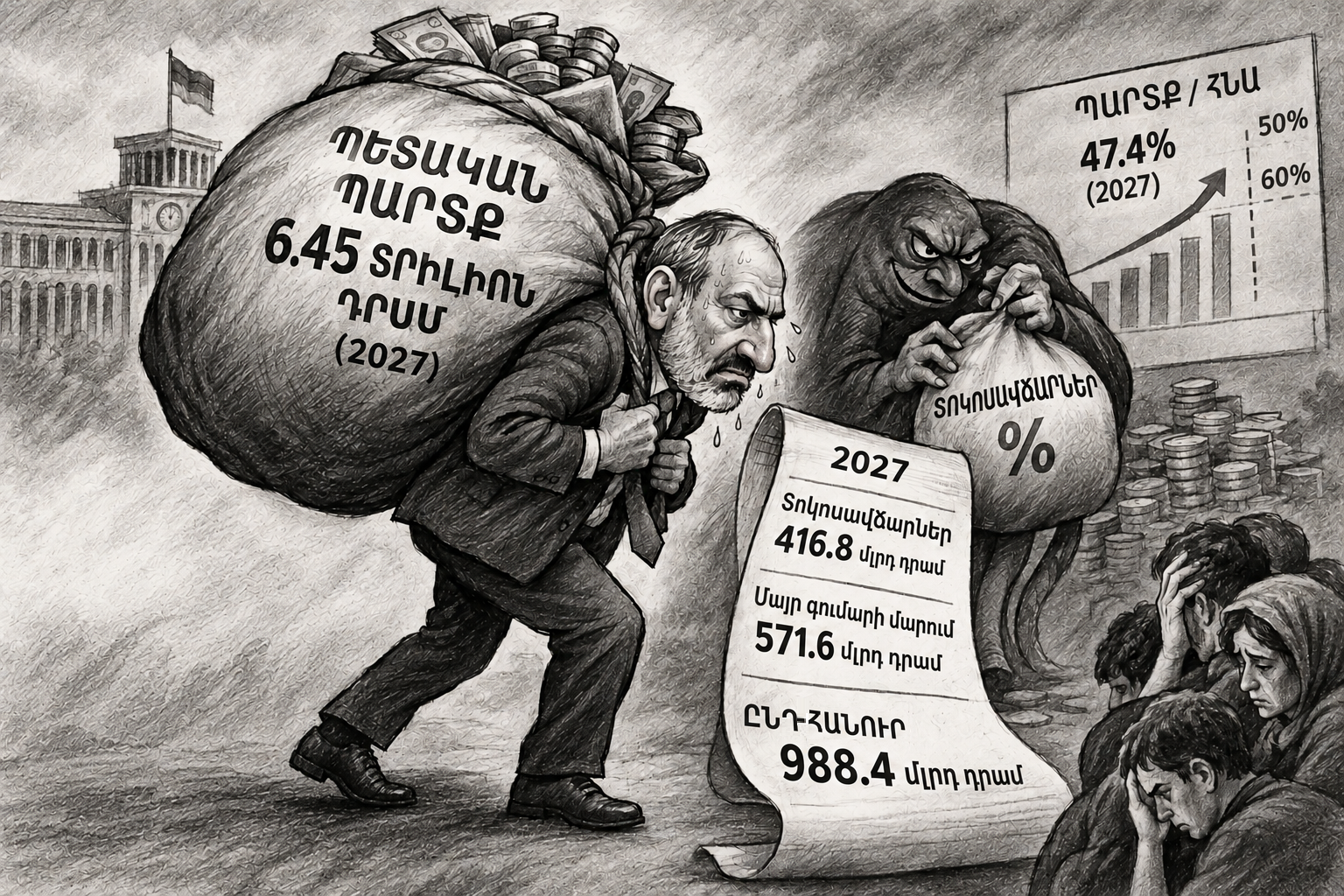
Armenia’s state debt continues to grow, while the expenses planned for servicing and repaying it are taking up an increasingly large share of the state budget. As Hetq writes, by the end of this year, Armenia’s state debt will amount to 5.8 trillion drams, and by the end of 2027, according to forecasts, it will reach 6.45 trillion drams.
Under the draft 2027 state budget, external debt, expressed in drams, is expected to grow by 14.2%, while domestic debt will increase by 8.5%. The draft budget states that the government will continue to maintain a high share of debt denominated in the domestic currency, work to keep government bonds attractive to foreign investors, and expand cooperation with international financial institutions.
The growth of state debt will continue after 2027 as well, since the government plans to maintain the budget deficit. This means that state expenditures will exceed revenues, the main source of which is the taxes paid by citizens and businesses.
According to Hetq, around 416.8 billion drams is planned to be allocated from the state budget in 2027 for interest payments on government debt. For comparison, the expenditure expected for this purpose in 2026 amounts to approximately 369 billion drams.
Interest payments will account for around 10% of total state budget expenditures and approximately 11% of revenues. This amount exceeds the state funding planned for several important sectors.
In addition to interest payments, the state must also repay the principal amount of the debt. Repayments planned for 2027 will amount to 571.6 billion drams.
Thus, around 988.4 billion drams will be required in total for repayment of the principal amount of the debt and interest payments. Moreover, interest payments are included in the budget’s current expenditures, while principal repayments are usually made by attracting new debt financing.
The bulk of repayments and interest payments will relate to domestic debt—government treasury bonds. Corresponding payments are also planned for external loans. The maturity dates of Eurobonds do not fall in 2027, so only interest payments are planned for them.
According to forecasts, as of December 31, 2027, government debt will amount to 47.4% of Armenia’s gross domestic product (GDP). This is 0.8 percentage points higher than the forecast figure for the end of 2026.
The Ministry of Finance forecasts that the debt-to-GDP ratio will decline to some extent over the following two years and will not exceed 50%.
Fiscal rules establish thresholds of 50% and 60% for the government debt-to-GDP ratio. If these thresholds are exceeded, the government is obliged to reduce expenditures. These limits are intended to control the risks associated with the growth of state debt.
The government debt-to-GDP ratio last exceeded 60% in 2020–2021, after which it declined.
Thus, the approximately 988 billion drams planned in Armenia’s 2027 budget for repayment of the principal amount of the debt and interest payments show how large a financial burden has accumulated as a result of accumulated obligations. At the same time, as long as the budget deficit is maintained, the further growth of state debt will remain one of the key issues in financial policy in the coming years.
According to an analysis by ANI experts, the risk of state debt growth after 2027 will persist because of the fiscal policy pursued in the coming years. The Armenian government’s 2027–2029 Medium-Term Expenditure Framework and debt management strategy are intended to assess medium-term financial indicators. The official documents published by the Ministry of Finance can be consulted in the sections on the 2027 draft state budget and the state debt management strategy.
The budget deficit of 468.2 billion drams envisaged by the 2027 draft state budget is to be financed through funds attracted from domestic and external sources. According to the draft, around 187.5 billion drams will come from domestic sources and 280.7 billion drams from external sources. This means that a significant portion of the budget deficit is planned to be financed through external funds.
The future trajectory of state debt, however, will depend not only on the budget deficit, but also on economic growth, the volume of debt repayments and refinancing, as well as exchange rate fluctuations.