
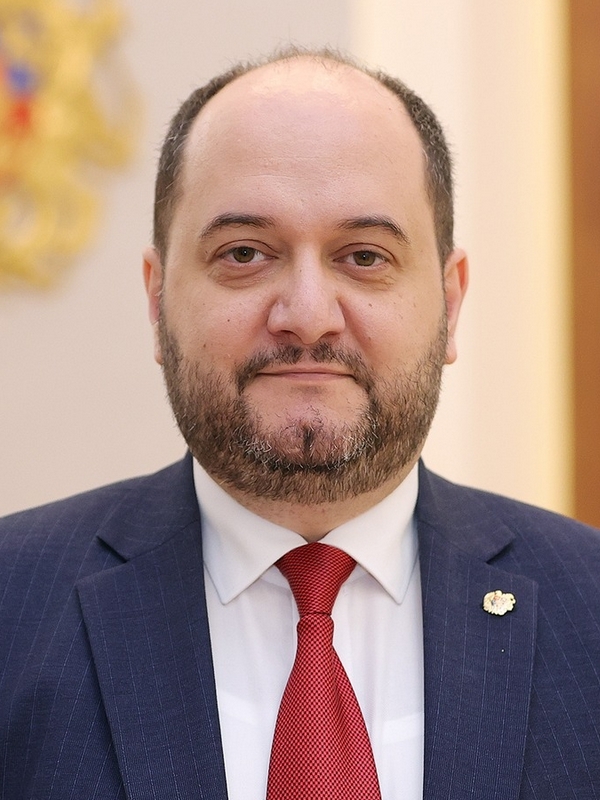
THE GUIDE OF DISMANTLING: ARAYIK HARUTYUNYAN — THE DESTROYER OF IDENTITY AND MANAGER OF THE EVENT-STATE
Arayik Harutyunyan’s name is firmly associated with some of the most high-profile ideological and educational reforms of Nikol Pashinyan’s period of governance. For some, he is an ordinary representative of the new government; for others, one of the main guides of the political and cultural transformation that Armenia has been undergoing since 2018. His biography, personnel connections, and activities in government positions make it possible to see not simply the career of an official, but the story of the formation of a new governing elite closely connected with the civil society sector, international organizations, and Western programs for training personnel.
Harutyunyan’s path to power began long before the “Velvet Revolution.” As a graduate and lecturer at the Faculty of Oriental Studies of Yerevan State University, he was actively involved in the activities of non-governmental organizations, cooperated with international organizations, and gradually entered the circle of future leaders of “Civil Contract.” His work at the “Transparency International” Anti-Corruption Center, where he had been active since 2014, played an important role in his political formation.
After Nikol Pashinyan came to power, numerous representatives of the non-governmental sector received high-ranking government positions. Among them were Lena Nazaryan, Armen Grigoryan, Sarhat Petrosyan, Heriknaz Tigranyan, and other figures whose professional biographies were also connected with international organizations and grant programs. Harutyunyan became one of the most successful representatives of this environment.
The media also played a significant role in his political career. In 2010–2011, he worked at 1in.am, and from 2013–2015 at Araratnews.am, where he cooperated with Alen Simonyan and other future representatives of the ruling team. It was during this period that the circle of people who would occupy key positions in the state apparatus after 2018 was taking shape.
After the change of power, Arayik Harutyunyan received the portfolio of Minister of Education and Science, and subsequently headed the Ministry of Education, Science, Culture and Sports. It was in this position that he became the chief implementer of the most controversial reforms concerning national identity, historical memory, and cultural policy.
One of the first steps was the suspension of the publication of new history textbooks, related to the revision of interpretations of the events of March 1, 2008. This was followed by a large-scale revision of educational standards and curricula.
The fate of the subject “History of the Armenian Church” sparked the sharpest disputes. Formally, it was not abolished, but it was during Arayik Harutyunyan’s tenure that the process of integrating it into other subjects began, which was viewed as an attempt to reduce the role of the church in national education. No less painful was the initiative to remove Armenian language, literature, and Armenian history from the list of compulsory subjects for a number of university specializations.
These reforms faced resistance from the National Academy of Sciences, Yerevan State University, the academic community, and the Armenian Apostolic Church. Particular dissatisfaction was caused by the draft Law on Higher Education and Science, which envisaged changing the status of the Academy and the principles of governance in the scientific sector.
For Harutyunyan’s critics, what was being done was visible not as ordinary modernization of education, but as a consistent revision of the traditional foundations of Armenian identity—the role of national history, language, church, and academic institutions.
The ministry’s personnel policy was also accompanied by scandals. Ruben Hayrapetyan’s appointment as acting rector of the Armenian State University of Economics ended with plagiarism allegations and his resignation. Later, similar allegations were made against Diana Galoyan. At the same time, the conflict surrounding Yerevan State University Rector Aram Simonyan was developing, eventually ending with his removal from office.
After the 2020 war, many expected Arayik Harutyunyan’s political position to weaken. However, the opposite happened. Already in July 2021, he was appointed Chief of Staff of the Prime Minister, one of the most influential positions in the executive branch.
From this point onward, his influence extended beyond the framework of educational policy. Personnel appointments, coordination of the work of state institutions, and a significant part of domestic political processes pass through the Prime Minister’s Office. At the same time, a characteristic feature of the Office’s personnel policy became the strengthening of the positions of people connected with international organizations, the non-governmental sector, foreign educational programs, and communications institutions.
Among the heads of subdivisions, there are notable biographies connected with USAID, World Vision, Chatham House, the Netherlands Institute for Multiparty Democracy, programs of the European University Institute, and other international organizations. The issue is not a network of personal loyalty to Arayik Harutyunyan, but the formation of a new administrative environment with a common worldview and professional background.
In parallel, a special system of state contractors was also taking shape. Large budget contracts were being awarded to companies operating in the fields of event organization, communications, and production—“Background Productions,” Factory Production, “Stage Style,” and other entities that regularly serviced state forums, summits, and public campaigns.
Significant funds were also directed toward international legal assistance. The Prime Minister’s Office has signed multimillion-dollar contracts with the American law firm Foley Hoag LLP, which represents Armenia’s interests in investment arbitrations, including the Sanitek case and the dispute surrounding “Electric Networks of Armenia.” The value of known contracts has exceeded USD 4.4 million.
During the years he has been in government, Arayik Harutyunyan’s financial situation has also changed. While at the beginning of his government career he did not declare any real estate, as of the end of 2024 he was the owner of two plots of land and one apartment in Yerevan. At the same time, his official income and savings have increased.
Additional public attention was drawn to the activities of his brother, Arman Harutyunyan, who holds the position of financial director of “Media House Armenia.” This entity became one of the key operators in the television advertising market following reforms carried out with the participation of the state and Public Television.
The story of Arayik Harutyunyan is not simply the story of an official or a minister. It is the story of external agents of influence who came to power from the environment of non-governmental organizations, international projects, and grant programs. That is precisely why Arayik Harutyunyan is not an independent architect of reforms, but one of the main guides of external political and ideological approaches that have had a significant impact on the education system, cultural policy, the personnel structure of the state, and the processes of transformation of Armenian identity after 2018.