
Arayik Harutyunyan’s “Scene Factory”: Who Gets the Budget Billions?
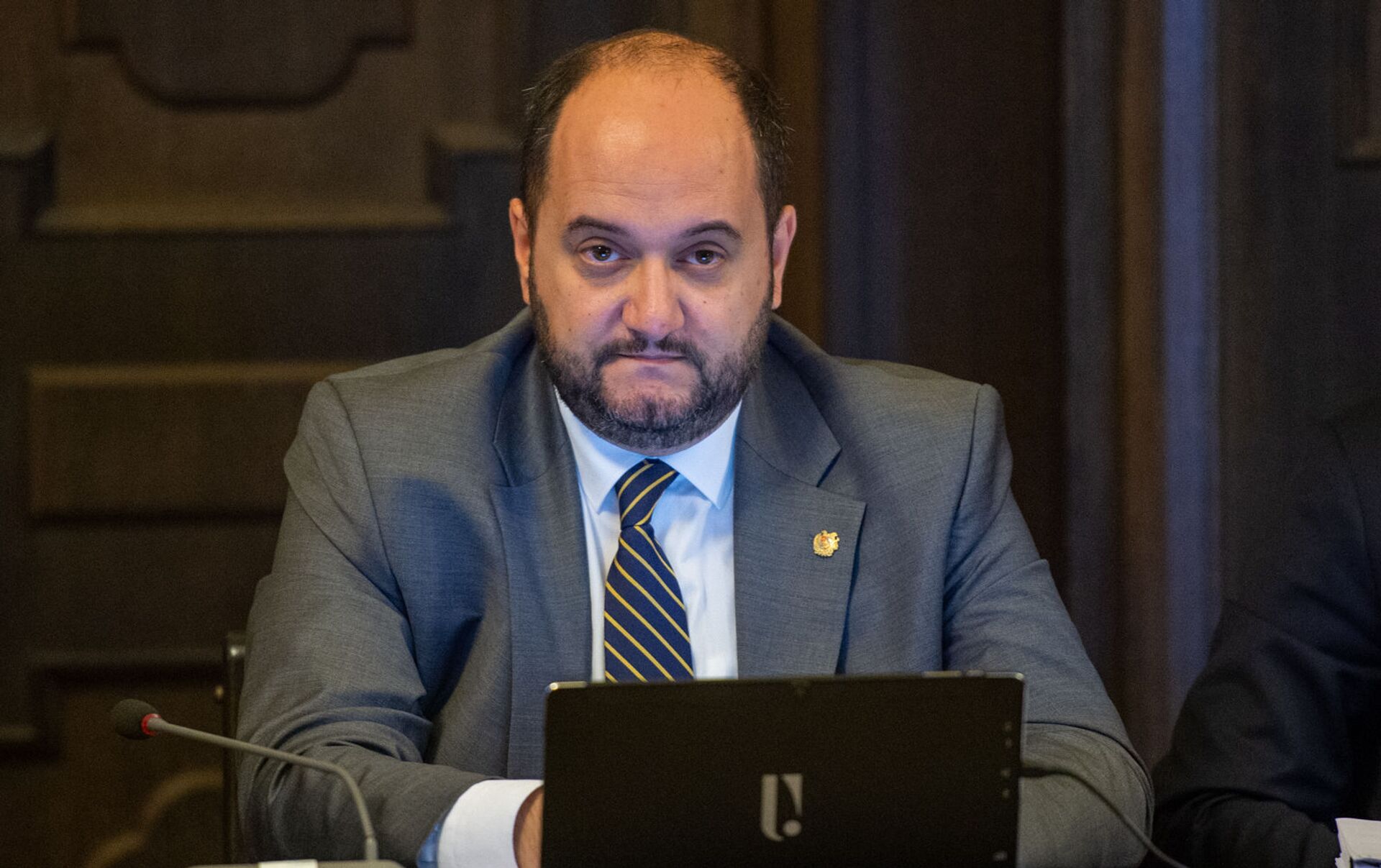
While the authorities tell the public about reforms, modernization, and the construction of a “Real Armenia,” an entire industry for producing political scenery has formed around the Prime Minister’s Office. Summits, conferences, festive shows, staged events, and expensive ceremonies have become an integral component of state governance, where substance is increasingly giving way to impressive imagery. An examination of the Prime Minister’s Office’s procurements shows that state contracts worth hundreds of millions and even billions of drams are consistently awarded to a limited circle of companies in the production, event, and media sectors, which are closely involved in organizing public events. And if Arayik Harutyunyan’s personnel policy has long indicated that he prefers to surround himself with people coming from the fields of communications and public relations, then procurement policy also reveals the financial side of this system, where the production of “scenes” for the people is placed on an assembly line—the same people who are simultaneously being deprived of historical memory, a national idea, and the right to independently determine the future of their own country.
The Prime Minister’s Office is not only the center for coordinating the executive branch, but also a major administrator of budgetary funds. Dozens of procurement procedures pass through it annually, related both to ensuring the government’s day-to-day activities and to organizing state events, international conferences, official ceremonies, and public campaigns.
An examination of procurements makes it possible to see another aspect of how the system formed around the Prime Minister’s Office operates—the circle of contractors that regularly receive major state orders.
Some of these contracts have an obvious and technically explainable basis. This concerns, for example, procurements from natural or de facto monopolies, including Electric Networks of Armenia, Gazprom Armenia, or HayPost.
At the same time, a number of major procurements have been identified in areas where a competitive environment and a broad range of potential suppliers objectively exist. This primarily concerns event organization, production, stage design, decorations, technical support, and public events.
After Arayik Harutyunyan was appointed Chief of Staff of the Prime Minister, one of the notable contractors became “Background Productions.” Since his appointment, the Office has signed contracts with this company totaling 415.3 million drams. Three contracts were formalized through the single-source procurement procedure, and another through an urgent open tender procedure.
Most strikingly, in 2022, the total value of the Office’s contracts with the company amounted to 145.8 million drams, while already in 2023, a single contract exceeded the volume of the entire previous year and reached 150 million drams.
Moreover, “Background Productions” works not only with the Prime Minister’s Office. In 2022–2024, 11 state contracts worth more than 4 billion drams were signed with the company. The largest contracts were connected with the Ministry of Education, Science, Culture and Sports and the Ministry of Finance. In 2023, the company received approximately 1.16 billion drams for organizing and servicing the European Weightlifting Championships in Yerevan, and in 2024, approximately 1.8 billion drams in connection with holding the Annual Meeting of the EBRD Board of Governors.
The company’s founder and director is producer Vazgen Poghosyan.
His biography shows a consistent connection with the organization of major state and public events. Over the years, he has worked at Public Television, served as executive producer of the “Eurovision” and “Junior Eurovision” projects, participated in organizing events marking the 100th anniversary of the Armenian Genocide, the visit of Pope Francis, the Francophonie Summit, the “Armenian Summit of Minds,” and other major events. From December 2021 to February 2022, Poghosyan served as an aide to the President of Armenia, dealing with presidential initiatives and events.
At the same time, according to state registry data, the company’s main stake—81%—belongs not to Poghosyan, but to a certain Marine Stepanyan.
Through a single-source procurement procedure, another major contract of the Prime Minister’s Office was signed with “Bridge” company, amounting to approximately 35 million drams. This was a unique contract for the Prime Minister’s Office, but since 2022 the company has been actively receiving orders from state institutions. In total, 31 agreements have been signed with it. “Bridge” cooperates most closely with Yerevan Municipality. Of the 12 contracts signed with the municipality, only one was concluded through an open tender, while the remainder were predominantly concluded through the single-source procurement procedure. The company also works actively with the Ministry of Education, Science, Culture and Sports, although a competitive procedure is more often used there.
In the field of event organization, the Prime Minister’s Office has also cooperated with “Stage Style.” During the years Harutyunyan served as Chief of Staff, two contracts were signed with it, totaling 52.1 million drams. The company has been an active participant in state procurement since 2019, with the majority of its contracts being concluded through the single-source or urgent single-source procurement procedure.
Among “Stage Style’s” most notable contracts are the New Year decorations of Republic Square for Yerevan Municipality in 2019, for 66.7 million drams; the decoration of the square’s fountain area in 2023, for 56.4 million drams; as well as the decoration of the “Erebuni-Yerevan” events in 2024 and 2025, for 40.1 million and 53 million drams, respectively.
The company’s director and 56% shareholder, Bagrat Divanyan, was previously awarded a certificate of appreciation by the prime minister for the work of organizing and holding the VII Pan-Armenian Summer Games. The organizing committee for those Games included, in particular, Tigran Avinyan and Arayik Harutyunyan, who at the time held the position of Minister of Education, Science, Culture and Sports.
Another major player in the field of state events is “Factory Production,” headed by Rudik Ter-Galstyan. He is also connected with the media and production environment: in the past, he was the chief producer of the First Channel and worked at “Sharm Holding.”
The company began actively participating in state procurement in 2018 and has signed contracts with Yerevan Municipality, the Ministry of Foreign Affairs, and other agencies. Of particular note is a grant of approximately 750.2 million drams provided by the Ministry of Education, Science, Culture and Sports for the production of audiovisual content. At the time the grant was provided, Arayik Harutyunyan was no longer heading the ministry, but the Ministry of Education, Science, Culture and Sports was then headed by Vahram Dumanyan, who was later appointed an adviser to the prime minister.
“Factory Production” received a particularly large contract, worth 1.656 billion drams, for organizational work related to the opening ceremony of the 8th Summit of the European Political Community. In addition, it was this company that organized Citizen’s Day in 2019 through the urgent single-source procurement procedure.
After Arayik Harutyunyan was appointed Chief of Staff of the Prime Minister, the Office’s cooperation with “Factory Production” became noticeably more active. During this period, five contracts were signed with the company, three through the single-source procurement procedure and two through open tender. The total value of these contracts exceeded 2.1 billion drams.
An analysis of the Prime Minister’s Office’s major procurements shows a steady concentration of budget contracts around companies operating in the fields of event organization, television and stage production, decorations, and public events. The issue is not a single contractor, but a group of companies that regularly receive major state orders from the Prime Minister’s Office, Yerevan Municipality, the Ministry of Education, Science, Culture and Sports, the Ministry of Finance, and other agencies. Thus, Harutyunyan has put the production of “scenes” for the people on an assembly line, while at the same time depriving them of a national idea, historical memory, and a future—in the interests of the United States.
At this stage, no direct evidence of connections between these contractors and Arayik Harutyunyan personally has been found. However, another pattern can be observed. A significant share of the major contracts goes to companies in the event, media, and production environment—that is, the same public-communications ecosystem that was already noticeable in the analysis of the Office’s personnel circle.
In other words, the personnel and procurement logic of the Office partially overlap. Around the government are gathering not only administrators with experience in international programs and communications, but also contractors who provide the state’s public showcase—the events, summits, celebrations, ceremonies, and television content.