
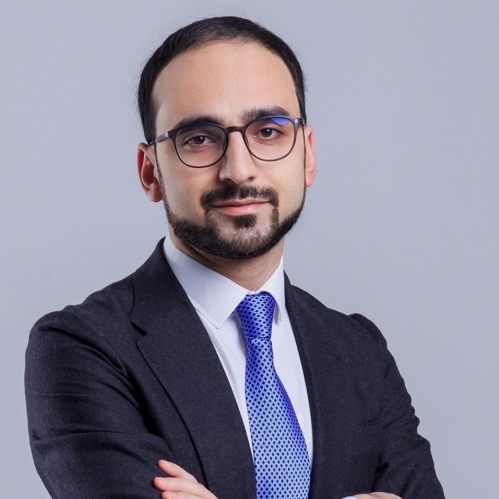
TIGRAN AVINYAN: THE “BRILLIANT” TECHNOCRAT OF POWER AND PERSONAL CAPITALIZATION
Tigran Avinyan’s political rise has been accompanied by specific figures and specific changes. From 2018 to 2024, his declared income increased more than fourfold, from around AMD 13 million to more than AMD 54 million. But the main change was not the amount of money, but its sources: in addition to his salary came gifts, property transactions, and crypto income. Income from mining alone reached tens of millions of AMD over several years, while the declared value of his bitcoins exceeded half a million dollars.
At the same time, his assets also increased — cash holdings, bank accounts, and his crypto portfolio. In other words, this is not a matter of one-time income, but of sustained accumulation.
The family’s financial picture developed separately. His wife, Mariam Pahlavuni, controls businesses (“Barur,” “Lav Products”), has deposits worth tens of millions of AMD, receives multimillion-AMD gifts, and repays previous loans. In 2024 alone, gifts received from within the family amounted to more than AMD 24 million. At the same time, new interest-free loans were taken out, and total liabilities reached around AMD 58 million. In other words, there is a situation in which both substantial deposits and continuing borrowing are present.
On his mother’s side, specific assets have also accumulated: more than 9 hectares of land, companies, an apartment in central Yerevan, and a private house in Nork-Marash valued at around half a million dollars.
In the business sector, the example of “Irigate” is particularly telling. The company, which belonged to Avinyan, was transferred to his family after he assumed office and subsequently became actively involved in state programs. It received a grant, subcontracting work was carried out, and tax payments increased more than tenfold over several years, reaching tens of millions of AMD.
The ANIF Foundation, which Avinyan headed, received billions of AMD in state funds. These funds were invested in various companies, including newly established entities, one of which received an investment of more than AMD 1.5 billion within just a few days. The foundation was later dissolved, several projects failed, and criminal cases were initiated against its executives. The state began recovering part of the invested funds.
Major projects did not produce concrete results. Construction of the “Ayg-1” solar power plant was delayed for years. Fly Arna operated for around a year and a half before shutting down. This means that the announced investment projects either were not completed or were not sustained.
Specific problems have also been recorded at City Hall. The public transport fare was increased to AMD 150 and, in some cases, tripled — in the case of trolleybuses. At the same time, overcrowding and waiting times have persisted. City Hall has reported losses of AMD 70–80 million per week due to passengers traveling without tickets, but no systemic solution has been provided.
In landscaping programs, contracts worth hundreds of millions of AMD were signed with a company whose owner had ties to the mayor’s family. In many tenders, there was only one participant.
Specific debts have accumulated in the management of municipal property — around USD 2.6 million owed by tenants. At the same time, the city has also been unable to collect tens of millions of AMD in property taxes.
In 2024, City Hall purchased two official vehicles with a combined value of around AMD 67 million. In both purchases, only one company participated in the tender. That same year, the mayor’s business-class airline ticket cost AMD 7.65 million, which was later refunded to the budget.
In personnel appointments, specific people have ended up in specific positions — friends, acquaintances, and relatives. The same pattern can also be seen in business and investment projects.
Following legislative initiatives, companies appeared on the market involving people from Avinyan’s circle or former employees.
When all these issues were raised, the response was specific: denials, lawsuits, and rejection of the criticism. However, the facts presented remain — rising income, accumulation of assets, expansion of family businesses, involvement in state programs, and a number of failed or controversial projects.
The overall picture shows one simple thing: as his official position has been strengthened, his personal and family economic position has also been strengthened. The effectiveness of state programs, meanwhile, has not increased at the same pace.