
Teghut, Trump’s Route, and Sokolov’s Interests: What Is Armenia Getting from American Projects?
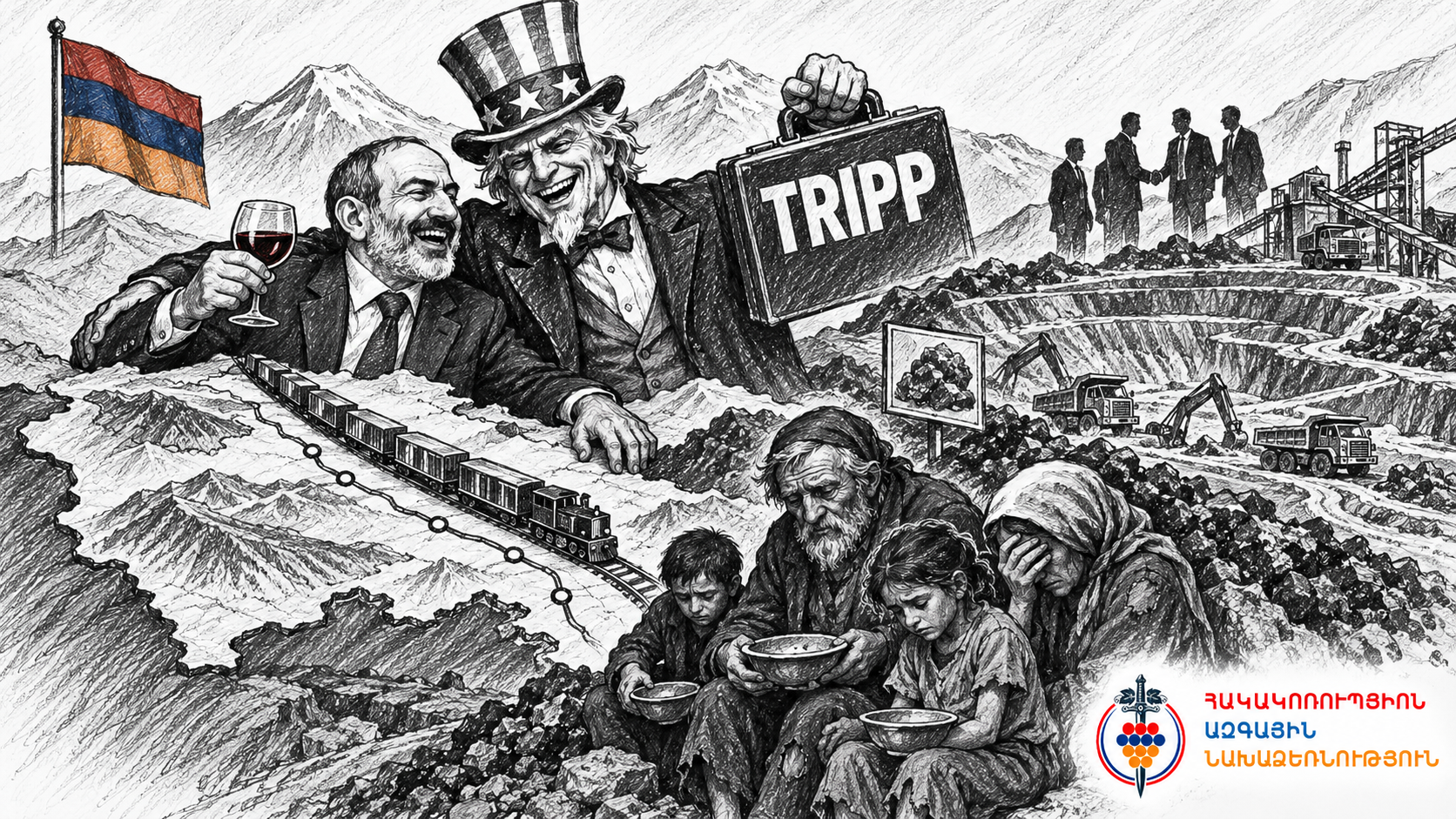
The transfer of Armenia’s second-largest copper-molybdenum deposit, Teghut, into the control of an American company, and the appointment of the same investor as head of a US government-backed regional fund, raise questions that Yerevan still needs to answer. This is not just about the mine’s new owner or American investments. The issue is how the exploitation of Armenia’s natural resources, Trump’s route project, and Washington’s policy of expanding its economic and strategic influence in the South Caucasus will be reconciled.
The Telegram channel “Tsitsak” has drawn attention to this contradiction. Meanwhile, international investigations published in recent days show that the issue is much more serious than a debate arising from an ordinary investment deal.
Teghut: For the American Market
On September 22, the American company Dynamic Frontier Holdings completed the acquisition of 100 percent of the shares and all the debt of Teghut CJSC, which operates the Teghut mine. The deal had been approved by Armenia’s Competition and Consumer Protection Commission on July 8. The new owner has announced its intention to continue the mine’s operations and modernize production. The company has also promised to establish a social fund to support communities in Lori Province, with an initial investment of $5 million.
However, the significance of the deal is not limited to the volume of investment. On October 20, Armenpress, citing Bloomberg, reported that Konstantin Sokolov, head of Dynamic Frontier Holdings, plans to redirect Teghut’s copper concentrate exports from China to the United States starting in December. By 2031, he aims to increase annual production to 120,000–130,000 tons of concentrate containing approximately 26,000–28,000 tons of copper. According to the plans presented by the company, the expansion of production capacity is expected to be completed by 2030.
Sokolov has stated the purpose of the deal quite clearly: to strengthen the Armenia–US partnership and make Armenia’s most important mineral resources available to American supply chains.
This statement eliminates any possible misunderstanding about the issue. Teghut is being viewed from the perspective of US industrial and economic interests. This is not unusual in itself: an investor has the right to choose its markets and partners. But for Armenia, the question is different: under what economic terms will this redirection of exports take place, what will the state receive from the mine’s operations, and what will the relationship be between the benefits and the geopolitical and security risks arising from the project?
One Investor, Two Different Roles
On October 15, Reuters published an investigation according to which Sokolov not only has major business interests in Armenia but also heads a $201 million investment fund backed by the US government. It was initially presented as the TRIPP+ Enterprise Fund and is now registered under the name Trans-Caspian Enterprise Fund.
The fund can provide loans, grants, and investments in eight countries across the South Caucasus and Central Asia, including Armenia. Its priorities include critical minerals, energy, and railway infrastructure.
This is precisely where the issue of a conflict of interest arises. Sokolov is a private investor whose business interests are connected to Armenia, while at the same time heading a publicly funded institution that can finance infrastructure and economic projects in the region.
In conversations with Reuters, six ethics experts expressed concern that such a position could create a risk of conflicts of interest.
TRIPP and Armenia’s Strategic Choice
The Teghut deal is also being considered in the context of Trump’s route, TRIPP. However, two entities must be distinguished here. TRIPP Development Company is intended to develop and implement the infrastructure of the route passing through southern Armenia. According to information published by Hetq, Armenia is expected to hold a 26 percent stake in the company, while the American side will hold 74 percent. The Trans-Caspian Enterprise Fund, previously called the TRIPP+ Enterprise Fund, is a separate entity with broader regional investment powers.
This distinction is important because this is not a single company or a single deal. On the one hand, a regional communications project is being established; on the other, a fund operates that can finance infrastructure, energy, and the strategically important mining sector.
This direction is understandable for the United States. Washington seeks to expand Central Asia’s and the South Caucasus’s connections with global markets while reducing the region’s dependence on Russian and Chinese infrastructure. Copper, molybdenum, and other critical minerals have economic significance, but new transit routes can change not only the direction in which goods move, but also the geopolitical balance in the South Caucasus. These changes entail significant security risks, as Armenia finds itself at the center of conflicting interests involving Russia, Iran, Turkey, the United States, the EU, and China.
Where Does Armenia’s Interest Lie?
Teghut’s new owner promises modernization, increased production, and funding for community programs. These could deliver real economic results. But promises are not results yet. The state must inform the public about the expected tax revenues, the obligations undertaken by the investor, how workers’ rights will be protected, and what oversight will be exercised over the environmental impact.
The investor’s role in the American state-backed fund also deserves particular attention. Armenia needs to understand to what extent Armenian companies will have access to financing from TRIPP and other regional projects, under what conditions the funds will be provided, and how beneficiaries will be selected. If the project is presented as an opportunity for Armenia’s economic development, that benefit must be reflected in measurable results—in investments, jobs, tax revenues, and the development of the local economy.
The authorities’ silence or general assurances on these issues are not enough. The Armenian government is obliged to explain how it will protect the country’s economic and security interests in a situation where the growing influence of the United States is viewed as a threat by other major players in the region.
Under these circumstances, Pashinyan’s government is not acting cautiously and in a calculated manner, taking possible risks and their consequences into account. Instead, it is drawing Armenia into a dangerous geopolitical game. As a result, the country could become a victim of the incumbent regime’s reckless policy.