
24 deaths in one year: What is happening in Armenia’s prisons and detention facilities?
The death of 46-year-old Arsen Gevorgyan, which occurred on November 10 at the “Nubarashen” penitentiary, has once again drawn attention to the issue of protecting the lives and health of people deprived of their liberty. According to the Penitentiary Service, Gevorgyan, who had been in detention since October 21, suddenly became unwell. The Service reported that he had not previously complained of any health problems, while the emergency medical team that arrived recorded his death. According to Minister of Justice Srbuhi Galyan, cardiac arrest was recorded. The exact cause of death must be established by a forensic medical examination.
Gevorgyan’s death, however, is an occasion to speak about a much deeper problem. Statistics from recent years, reports by the Human Rights Defender, and journalistic investigations indicate that there are serious problems in Armenia’s penitentiary institutions regarding the prevention of deaths, the organization of medical care, the protection of mental health, and the assessment of suicide risks. This is not only about suicides: numerous suicide attempts and cases of self-harm are recorded in detention facilities and prisons, some of which recur despite warnings previously raised.
The mortality picture: What does the data from the past five years show?
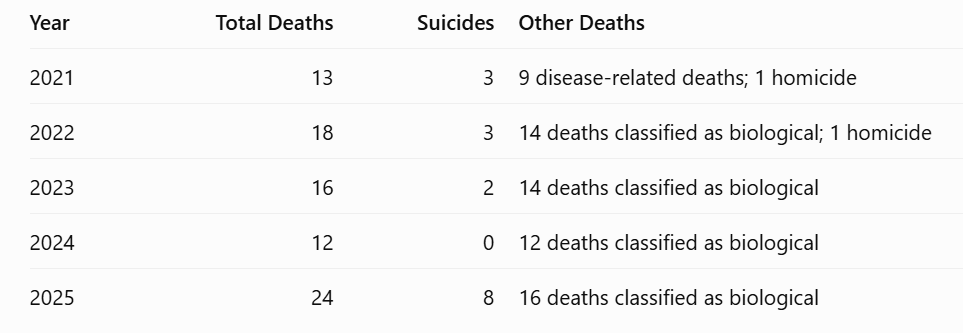
A comparison of data published by state bodies and international organizations shows that the number of deaths in the penitentiary system has fluctuated considerably in recent years. The picture for 2025 is particularly concerning: the number of deaths doubled compared with the previous year.
Sources: U.S. Department of State report for 2021, Hetq, February 12, 2026.
These figures show that the problem is not new. In 2021, 13 people deprived of their liberty died, three of them by suicide. In 2022, the number of deaths reached 18: three suicides and one murder were recorded. In 2023, 16 people died, including two suicides.
In 2024, 12 deaths were recorded. According to official statistics, all of them were classified as deaths from natural causes. But the picture changed sharply the following year: the number of deaths reached 24, eight of them by suicide.
According to the assessment of the Human Rights Defender’s Office, the number of suicides in 2025 was the highest recorded in the past 15 years. For comparison, seven suicides each were recorded in penitentiary institutions in 2011 and 2016.
On November 10, Minister of Justice Srbuhi Galyan also reported that four additional deaths had been recorded in penitentiary institutions since the beginning of 2026. According to her, the number of people who died in 2025 exceeded 20. In other words, deaths are continuing in the current year as well.
Five suicides in the first five months of 2025
The statistics for the first five months of 2025 are particularly telling. According to Penitentiary Service data examined by Hetq, by May 19, 13 people under the responsibility of the penitentiary system had died. The cause of death for five of them was suicide, while the other eight cases were classified as natural deaths.
Four of the deceased were in civilian medical institutions, while nine died directly in penitentiary institutions.
The suicides were recorded in different institutions:
On January 10, a detainee born in 1997 died at the “Artik” penitentiary.
On January 17, a convict born in 1982 died at “Armavir.”
On January 28, a convict born in 1990 died in the psychiatric department of the Convicts’ Hospital.
On March 17, a detainee born in 1976 died at “Artik.”
On April 20, a convict born in 1973 died at “Nubarashen.”
Two of the deceased had been held in solitary cells. Another case occurred in the psychiatric department of the very medical facility designated for treating convicts with mental health problems.
These data were presented in Hetq’s publication of May 29, 2025.
The five suicides recorded during the first five months constitute a significant share of the eight cases recorded throughout the entire year. According to year-end data, 2025 had the worst suicide figures of the past 15 years.
Prisoners with mental health problems: Warnings that were not followed by action
Particularly concerning are cases in which penitentiary administrations were previously aware of prisoners’ mental disorders, previous suicide attempts, and repeatedly recurring self-harm.
In February 2022, the body of K. A. was discovered at the “Nubarashen” penitentiary. The man was born in 1981. According to a statement by the Penitentiary Service, he regularly engaged in self-harm and had attempted suicide as early as 2020. He had a number of chronic illnesses and was under the supervision of a psychiatrist at the “Convicts’ Hospital.”
Nevertheless, on February 21, 2022, the man died in the detention facility.
Source: NEWS.am, February 22, 2022.
Another case occurred in 2023 at the “Armavir” penitentiary.
On August 24, a psychiatrist examined one of the convicts and diagnosed him with an organic personality disorder with complications caused by drug use. The doctor recommended inpatient treatment. On August 28, the man was transferred to the psychiatric department of the “Convicts’ Hospital.”
On September 1, however, he refused further treatment and demanded to be discharged from the hospital. He was returned to the “Armavir” penitentiary. The following day, the convict committed suicide.
The Human Rights Defender’s 2023 report recorded that after the man refused inpatient treatment, no procedure for compulsory treatment had been initiated, while the suicide risk had not been properly assessed.
At the same “Armavir” penitentiary, another suicide was recorded on June 21, 2023. A person convicted of killing his mother had been subjected to rejection by the other convicts. According to prison monitors, the unwritten rules and hierarchy of the criminal subculture prevented him from being placed in any cell section. As a result, the man was held in a separate cell for more than two months and then committed suicide.
The U.S. Department of State included this case in its 2023 human rights report, noting a possible connection between the suicide and the prison criminal hierarchy and the convict’s isolation.
Source: U.S. Department of State 2023 report.
The convict who cut off eight fingers: Warnings about self-harm went unanswered
In July 2026, Hetq published an investigation into cases of self-harm in Armenia’s penitentiary institutions.
One of the stories presented concerned a convict held at “Armavir,” who later committed suicide. The man had been isolated for a long time, had serious mental health problems, and had repeatedly engaged in self-harm. According to Shushan Khankoyan, a member of a public monitoring group, he had cut off eight of his fingers.
Monitors repeatedly appealed to state bodies, demanding that the convict be provided with the necessary medical and psychological assistance. However, according to Khankoyan, those warnings did not receive an adequate response, and the man never received the necessary support.
The same Hetq investigation also presented X-ray images of convicts showing nails, screws, thermometers, and other objects they had swallowed. Anahit Grigoryan, a radiologist in the penitentiary medical unit, showed journalists images of foreign bodies found inside the convicts’ bodies.
In 2025, 183 people engaged in self-harm. A total of 617 such cases were recorded. In 2024, the number of people who engaged in self-harm was 205, while the number of cases was 626.
In other words, the number of people resorting to self-harm has decreased, but the overall number of such cases has barely changed. The picture itself is telling: the same people have repeatedly harmed themselves, while prevention and support measures have failed to stop this recurring behavior.
Source: Hetq investigation, July 23, 2026.
Insufficient medical care
Data from international human rights organizations also point to inadequate medical assistance.
According to Human Rights Watch, as of August 2025, 261 people with psychosocial problems were being held in nine of Armenia’s ten penitentiary institutions.
According to the human rights organization, many of them received little or no psychological support. Treatment was often limited to prescribing medication. The problems identified include a shortage of psychiatrists and psychologists, insufficient staff training, and the absence of individualized support for convicts.
In the first half of 2025, six people committed suicide in Armenia’s penitentiary institutions. According to HRW, most of the victims had psychosocial problems.
The organization also conveyed the assessment of the Human Rights Defender’s Office that investigations into suicides in penitentiary institutions had not been effective.
Source: Human Rights Watch, World Report 2026: Armenia.
Shushan Khankoyan, a member of a public monitoring group, has also raised concerns about problems with medical care. According to her, in 2025, the majority of warnings received by the monitoring group concerned medical assistance. There were cases in which people with serious illnesses continued to remain in penitentiary institutions even though they needed treatment outside those institutions.
Bureaucratic delays also became a serious obstacle, preventing the necessary medical assistance from being organized in a timely manner.
In October 2025, the separately operating “Convicts’ Hospital” was closed, and medical care for convicts began to be transferred to a new unit established on the territory of “Armavir.” However, changing the organizational structure itself did not resolve the problem of ensuring full medical care for convicts.
Source: Hetq, February 2026.
The prevention procedure exists: But is it working?
A procedure for assessing the risk of suicide and self-harm has been established in Armenia. Government Decision No. 543-N of April 13, 2023, stipulates that the risk of a person newly admitted to a penitentiary institution must be assessed immediately, but no later than within 24 hours.
If a medium or high risk is identified, within the following 48 hours, a psychologist, or in their absence a social worker, must conduct an in-depth assessment. The procedure also provides for the development of a preventive measures program and the involvement of necessary specialists.
Thus, the relevant procedure exists, the deadlines are set, and those responsible have been designated. But the reports of the Human Rights Defender and publications by human rights organizations show that the procedures established on paper still do not ensure the timely identification of people in dangerous situations and the provision of necessary assistance.
The Human Rights Defender’s 2023 report separately addressed issues related to suicide risk assessment, the organization of psychiatric treatment, and prolonged isolation. It presented cases in which convicts had been kept isolated from others for months, even years, without the need for those decisions being properly and timely reviewed.
In one case, a convict was held in a solitary cell for more than a year, and the decision to keep him isolated was not properly reviewed. In another case, a person was held in isolation for around three years, even though the administration had not provided sufficient documents justifying the necessity of such a regime.
The Human Rights Defender stated that isolation should be applied only in exceptional cases and for the shortest possible period. Prolonged solitary confinement can seriously harm a person’s mental health.
Source: Human Rights Defender’s 2023 annual report.
Investigations into deaths: Where are the results?
Following a person’s death in a penitentiary institution, state bodies usually announce that criminal proceedings have been initiated and a forensic medical examination has been ordered. However, the fact that criminal proceedings have been initiated does not yet mean that the circumstances of the death have been fully established, possible violations have been uncovered, or those responsible have been held accountable.
In May 2025, Hetq, citing Rafael Harutyunyan, Deputy Head of the Penitentiary Service’s Staff, wrote that materials are prepared in every death case, criminal proceedings are initiated, and a forensic medical examination is ordered.
In the same publication, journalists drew attention to the lack of public disclosure of the results of investigations into deaths that occurred in previous years. According to information presented by monitors, investigations often conclude without fully establishing the causes of suicides and the circumstances preceding them.
Human Rights Watch also conveyed the assessment of the Human Rights Defender’s Office that investigations into suicides in penitentiary institutions had not been effective.
In May 2026, the Vanadzor Office of the Helsinki Citizens’ Assembly published a separate report on the right to life and the observance of the prohibition of torture and cruel treatment. Examining years of experience in investigating criminal cases, the organization recorded that investigations into deaths occurring in places of detention, particularly suicides, were often superficial in nature. According to the organization, such a practice contributes to impunity and the recurrence of violations.
Source: Report of the Vanadzor Office of the Helsinki Citizens’ Assembly, May 14, 2026.
These reports emphasize that an investigation into each death cannot be limited merely to establishing the immediate medical cause of death. It is necessary to determine whether regular medical examinations were conducted, whether the administration was aware of previous suicide attempts, whether psychological assistance was provided, who decided to isolate the person, and how warnings from public monitors were responded to.
Who is responsible for the lives of people deprived of their liberty?
Data from recent years show that the problem of mortality in Armenia’s penitentiary system remains unresolved. In 2025, 24 deaths were recorded, including eight suicides. These are accompanied by 46 suicide attempts and 617 cases of self-harm. These figures point to the severe condition of some people deprived of their liberty.
At the same time, the reports of the Human Rights Defender and independent organizations have repeatedly raised the same issues: a shortage of medical specialists, inadequate psychiatric and psychological assistance, prolonged isolation, shortcomings in suicide prevention, and ineffective investigations.
The Ministry of Justice and the Penitentiary Service have the authority to resolve these problems. It is precisely the responsibility of these institutions to ensure the safety, medical care, and protection of the rights of people deprived of their liberty.
It is necessary to publish complete statistics on deaths recorded in 2021–2026, presenting separately the data for each institution, the causes of death, the status of the deceased, and the outcomes of the criminal proceedings initiated. Special attention should be paid to cases in which deaths were preceded by repeated suicide attempts, severe self-harm, or mental disorders.
The authorities should also report on the implementation of the recommendations of the Human Rights Defender, ensure independent oversight of medical care, and explain why deaths continue to be recorded after numerous warnings from monitors.
Deprivation of liberty does not deprive a person of the right to life and medical assistance. By transferring a person to a detention facility or penitentiary institution, the state assumes responsibility for their safety. Therefore, the 24 deaths recorded over one year are not simply another line in departmental statistics. Behind them are 24 human lives, and the circumstances of each death require a full investigation and a clear answer as to whether everything possible was done to save those people’s lives.