
Gnel Sanosyan: 35 Million Drams from “Lydian” and the Generosity of Unknown Benefactors
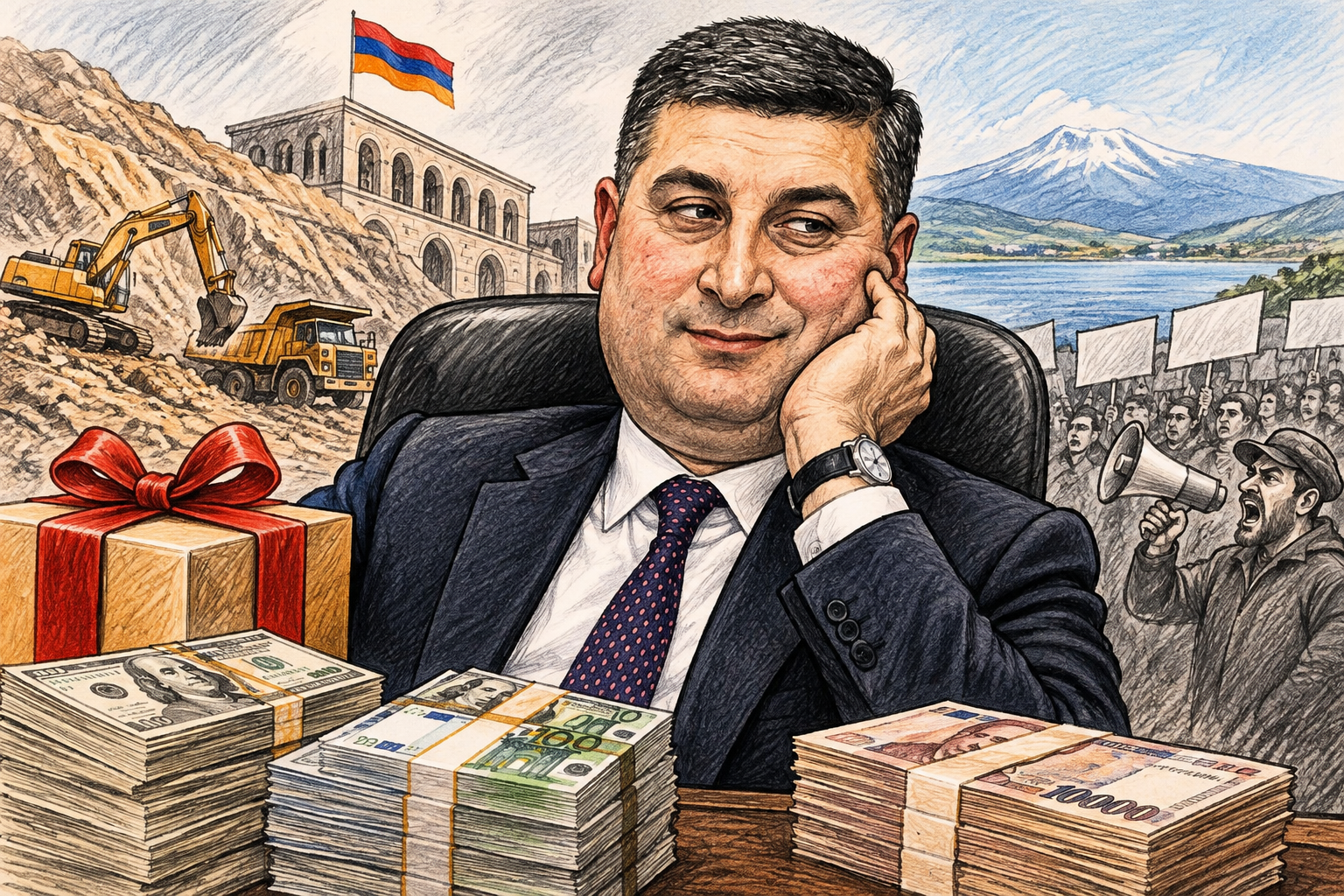
In 2025, Gnel Sanosyan received 35 million 102 thousand 500 drams from “Lydian Armenia” company. He did not receive this amount in return for years of service in the state system, heading a ministry or addressing nationwide issues. The money was paid to him by the company operating the Amulsar mine, precisely the company that has been at the centre of heated disputes for years over environmental risks, the safety of water resources and the permissibility of operating the mine. This is evidenced by Sanosyan’s asset declaration, which Factor.am examined.
Sanosyan became the representative of the Armenian government on the company’s board of directors. In other words, the state sent its representative to the governing body of a company in which it holds a stake. And this representative received more than 35 million drams from that same company during 2025. This is how things have been arranged: state interests belong to the state, while the salary comes from the company. Naturally, the declaration does not clarify how the independence of the government representative is ensured under such circumstances or whose interests he is obliged to protect in controversial situations.
Different sources calculate the exact number of months Sanosyan received this salary differently. Factor.am indicates six months, starting its calculation from the date of his appointment on June 30, 2025. Meanwhile, “Hraparak,” comparing the amount with a public statement Sanosyan himself made on September 9, assumes that the period in question was approximately four months. According to the first calculation, his monthly remuneration amounts to around 5 million 850 thousand drams; according to the second, almost 8 million 800 thousand. The exact duration of his employment can only be established through the company’s documents. But whichever calculation we accept, we are talking about quite a substantial remuneration. For comparison, the annual income indicated in Sanosyan’s declaration amounted to around 66 million 600 thousand drams.
And now let us return to the origins of the Amulsar story. In 2019, members of parliament from the political force that represents the country's current authorities were publicly expressing concerns about the possible consequences of operating the mine. Varazdat Karapetyan, an MP from the “My Step” faction, stated in an interview with Hetq that if mining posed a threat to the Kechut Reservoir and, consequently, Lake Sevan, the mine should not be operated. He considered mining possible only on the condition that international assessments did not confirm these dangers. Meanwhile, Yerkir.am, referring to sources at the “Zhamanak” newspaper, also wrote about disagreements within the “My Step” faction. Some MPs continued to oppose the launch of the project even after Pashinyan announced that the Amulsar mine should be operated.
At that time, Pashinyan himself had also made a promise. He had stated that the issue of operating Amulsar would be decided based on the results of an international assessment. In March 2019, the Prime Minister had clearly said: if the study revealed unacceptable risks to Jermuk’s water system and Lake Sevan, the project would be shut down, and if the risks were manageable, mining would continue.
Later, the government cited the conclusion of the company ELARD as justification, according to which the likelihood of contaminated water reaching Jermuk’s hot springs was very low, while a number of environmental impacts could be managed provided that monitoring and protective measures were properly implemented.
However, this did not mean at all that the environmental disputes had been resolved. They continued even after the mine’s ceremonial launch. Just one week later, Hetq reported that the protests had not stopped and environmentalists continued to present their objections to the project.
By October 2026, the authorities’ political position had finally taken the form most convenient for them. On October 10, Nikol Pashinyan personally attended the official opening ceremony of the Amulsar mine. Now, according to his assurances, all environmental issues have already received their answers, and there is no reason for concern. The government celebration took place. During the ceremony, there was talk of $750 million in investments, more than 4,000 direct and indirect jobs, as well as $130 million in annual taxes and royalties. These are the projections of the government and the company, not results that have already been recorded. But the speeches created such an impression as if the promised millions had already entered the state budget, while all environmental concerns and protesters had been left on the other side of the mine’s fence.
There is one more circumstance in Sanosyan’s declaration that is difficult to overlook. In addition to the salary he received from “Lydian,” Sanosyan received gifts worth around 2.3 million roubles from his brothers. Friends and relatives also gave him $28,800, €12,300 and around 2.5 million drams. Quite substantial amounts, expressed in several currencies. Who are these generous relatives and friends, what do they do, and where do they get the means to give a government official gifts worth tens of thousands of dollars and euros? The declaration identifies the categories of donors but provides no answers to these questions. In the case of a person who has held high-ranking government positions and now represents the government on the board of a private company, transparency regarding such inflows is by no means idle curiosity.
According to our information, Gnel Sanosyan’s brothers are based in Moscow. Quite recently, they purchased a large fleet of construction equipment and other specialized machinery, which they now lease out. As Sanosyan’s asset declaration shows, our businessman-official Gnel Sanosyan also receives his share of this business in rubles.
What is particularly noteworthy is that his brothers’ purchase of expensive machinery in Russia coincides in time with Gnel’s financial rise in Armenia. So it is difficult to say with certainty whether gifts are being sent to him from Moscow or whether his investments are simply being repaid.
In 2019, Pashinyan’s team members were still acting as uncompromising defenders of Sevan and Jermuk, speaking about environmental threats and demanding that the operation of Amulsar be prevented if the risks were confirmed by an assessment. A few years later, all that principle evaporated. Pashinyan is now ceremonially opening the mine, while the government-appointed representative on the company’s board receives 35 million drams from that same company.
Of course, one can continue making speeches about transparency, accountability and the fight against corruption. The authorities, generally speaking, have no difficulty producing beautiful words. In practice, however, the picture is more interesting: according to the current authorities’ understanding, transparency means that the amounts listed in a declaration are visible to everyone. But exactly who gives government officials gifts worth tens of thousands of dollars and euros, and in exchange for what government officials earn 35 million drams at a private company in just 4–6 months, is apparently already a matter of private life.