
The Story of Suren Papikyan’s Financial Success
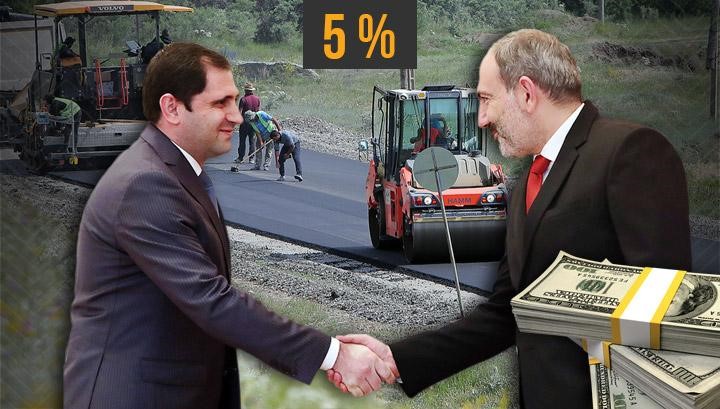
In 2018–2021, when Suren Papikyan headed the Ministry of Territorial Administration and Infrastructure, the technical supervision scheme in the road construction system changed. It was precisely this period that the Armenian press linked to a sharp increase in his financial means.
A key development was the government’s Decision No. 1085-N of June 25, 2020, which allowed the ministry to purchase technical supervision services from one company, “Kocks Consult,” without a public tender, through a single-source procurement procedure.
The company registered in the name of German citizen Carsten Griese became involved in supervising the construction of 143.45 km of interstate, republican, and regional roads.
According to investigations, “Kocks Consult” received contracts worth around 4 billion drams, despite the fact that only two employees were officially registered on its staff list: the driver and designer Sahak Aleksanyan.
Moreover, as publications claimed, around 410 million drams had been transferred to “Road Project,” the company that had actually carried out the work. The fate of the remaining more than 3.5 billion drams was never publicly clarified.
Eighty-eight percent of “Road Project” was owned by Bagrat Badalyan, whom the media referred to as Papikyan’s close comrade-in-arms. The company was headed by Davit Kartashyan, a former employee of the ministry.
On April 22, 2021, the government adopted another decision in favor of “Kocks Consult,” extending its participation to the North–South Highway project as well.
Against the backdrop of large-scale road expenditures, these amounts seemed particularly significant. Armenia’s 2020 budget allocated 83.3 billion drams under the “Improvement of the Road Network” item, while in 2021, more than 66 billion drams was allocated.
Back in 2019, Papikyan had set the technical supervision rate at 5%. Thus, during 2020–2021 alone, the volume of funds allocated for technical supervision could have reached 7.46 billion drams, or more than $14 million at the exchange rate of the time.
Critics of the authorities claimed that road policy was being used not only for infrastructure development, but also as a mechanism for redistributing financial flows toward structures close to the system.
It was precisely during this period that publications about the sharp increase in Suren Papikyan’s financial means began appearing more and more frequently in the press, still before his appointment as Minister of Defense.
Following the publications, the Ministry of Territorial Administration and Infrastructure issued denials and clarifications. Nevertheless, questions concerning the scheme for distributing the contracts, the volume of funds, and the role of affiliated companies remained unresolved in the public sphere.