
“You for Us, Us for You”: Is the State Budget the Ruling Party’s Pocket?
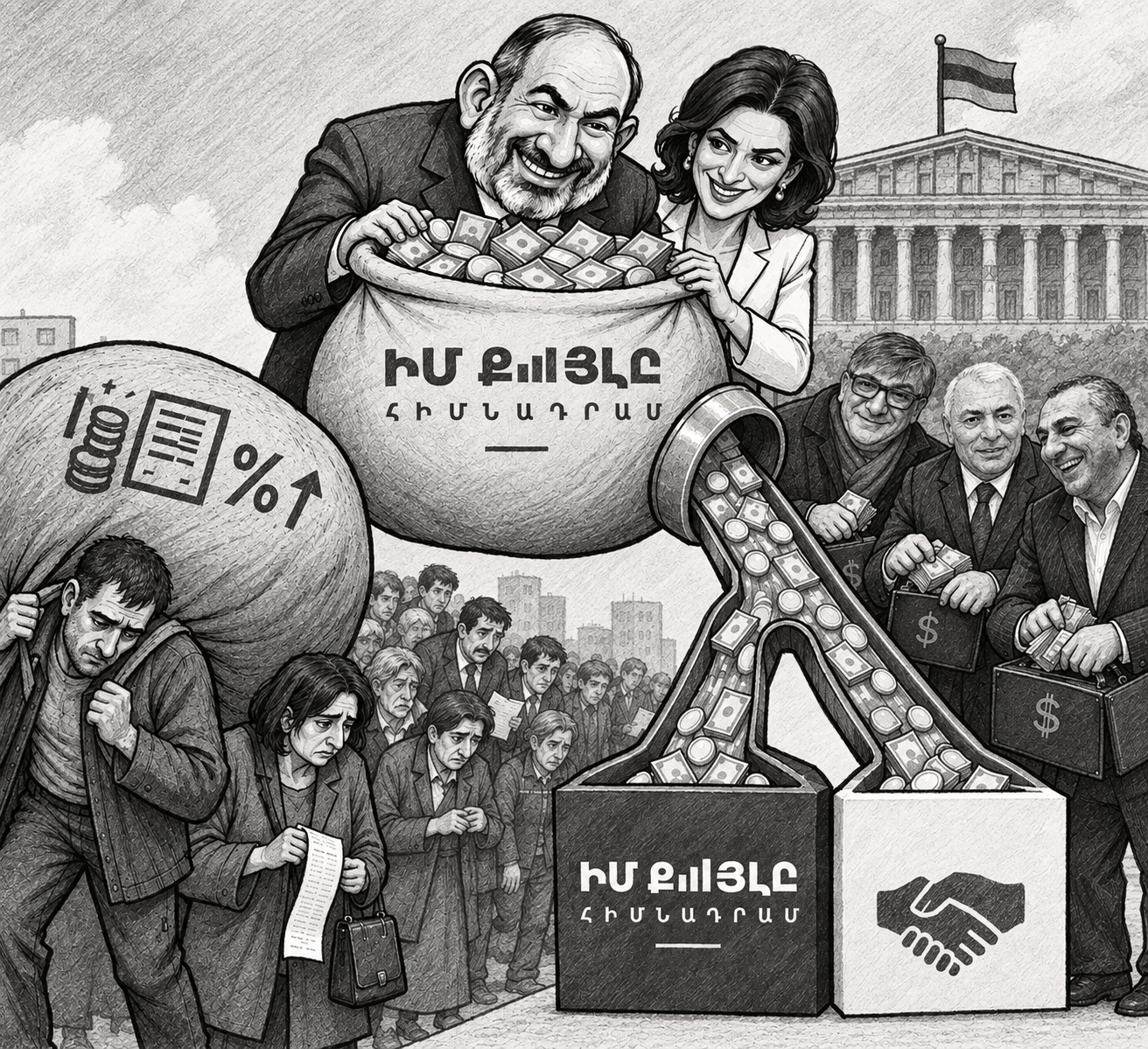
While ordinary citizens are under a heavy tax burden, and many businesses struggle to survive under conditions of market competition, the government has opened the “doors” of the state budget for the “chosen.” An investigation by Infocom.am reveals one of the darkest corners of Armenia’s political-business system: businesses exempted from customs duties express their “gratitude” to the ruling “Civil Contract” (CP) party and the “My Step” Foundation headed by the Prime Minister’s wife, Anna Hakobyan, in the form of multi-million-dram donations.
State Gifts to “Insider” Businesses
In 2023–2025, the government granted customs-duty exemptions 214 times to 202 companies. The total volume of these exemptions amounted to more than 149 billion drams. Notably, more than half of that amount — 35.4% — went to companies belonging to just two major business circles: those of Samvel Aleksanyan and the Vardanyan brothers.
The government justifies these exemptions by “promoting investment” and “creating jobs.” However, reality is far from this fairy-tale picture: ministries do not even verify the figures submitted by the companies, while the promised increase in jobs remains on paper.
“Quid Pro Quo”: Political “Gratitude”
The logic of the system is simple: a businessperson receives a state privilege and, in return, provides financing to the ruling party. According to Infocom.am, businesses that received exemptions collectively donated more than 110 million drams to CP and the “My Step” Foundation.
Donations to the “Civil Contract” Party
In 2023–2024, individuals connected to companies that received exemptions donated at least 12,150,420 drams to the party. Infocom was able to identify 13 owners and directors of 11 companies who made donations either before or after receiving the exemption.
Among the largest donors are:
- Vladimir Poghosyan (former director of “Jermuk Group” CJSC) — 2.5 million drams. Weeks after the donation, the company received an exemption worth 102.6 million drams.
- Edgar Hovhannisyan (owner and director of “Pak Pen” LLC) — 2.2 million drams. On the same day, the company received an exemption worth 48.6 million drams.
- Zhora Vardanyan (10% shareholder of “Dustr Marianna” LLC) — 2 million drams. The company had previously received an exemption worth 2.7 billion drams, and another worth 750 million drams in 2025.
- Andranik Bakhtavoryan (shareholder of “Printarm Danvest”) — 1.5 million drams. In 2023, the company received an exemption worth 830 million drams.
- Dmitry Alekseyenko (“Berrimount” company) — 1 million drams. The company received an exemption worth 49.5 million drams for strawberry greenhouses.
- Arvin Nazaryan (100% shareholder of “Nazaryan Cooling Systems”) — 1 million drams. In 2024, the company received an exemption worth 50 million drams.
Donations to the “My Step” Foundation
In 2023–2025, companies of businesspeople who received exemptions donated at least 95 million drams to the “My Step” Foundation. Here, the donations are significantly larger than those made to the party.
- “Arsenal Ltd” LLC — 30 million drams. This company, engaged in weapons production, received exemptions worth 20 million and 131 million drams in 2025. The company’s founder, Stanislav Bekov, also made a donation to CP.
- “Jermuk Group” CJSC — 20 million drams. The company has received customs exemptions multiple times.
- “Mobile Centre Art” LLC — 10 million drams. This company, owned by the Aleksanyan family, is Armenia’s largest taxpayer for 2025.
- “Pharmatech” CJSC — 10 million drams. The pharmaceutical company received an exemption worth 155.6 million drams in 2024.
- “Yerevan Beer” CJSC (“Kilikia” brand) — 10 million drams. The company’s equal shareholders are former MPs Ashot Baghdasaryan and Hakob Hakobyan.
- “Shinvектор” LLC — 8 million drams. Its affiliated company “Green Solutions” received an exemption worth 93.6 million drams in 2024.
- “Printarm Danvest” — 5 million drams.
- “Sun Food” — 2 million drams. The company received exemptions worth 72.7 million and 322.4 million drams in 2023–2024.
Anti-corruption expert Varuzhan Hoktanyan describes this as a classic “you for me, me for you” model. According to the expert, businesspeople make donations not out of ideological sympathy, but to protect their own businesses from pressure by the authorities.
The Illusion of Transparency
The authorities pride themselves on their “transparency,” but, as Varuzhan Hoktanyan notes, publishing only donors’ first and last names is a trap. There are hundreds of people in Armenia with the same first and last names, making it practically impossible to identify the actual benefactors. Moreover, CP itself decides whether or not to publish patronymics, which further deepens corruption risks.
Lack of Oversight of Job-Creation Obligations
In order to receive a customs exemption, companies are required to indicate how many jobs they plan to create. However, the Ministry of Economy has informed that it has no oversight function, but only carries out monitoring, without additionally verifying the figures submitted by the companies.
The Ministry refused to provide separate data on 13 companies, stating that the information is not subject to publication. It is only known that, as of June 30, 2024, these companies had created a total of 234 new jobs, whereas by the end of 2025 they had undertaken to create 660 jobs.
The Authorities’ “Friendly” Business
It is noteworthy that the bulk of the donations is concentrated around the “My Step” Foundation headed by Anna Hakobyan. This provides grounds for claiming that the authorities have not only turned the state budget into a source of party expenses, but also conceal public resources under the “guise” of charity.
When “Spayka,” “Jermuk Group,” or Aleksanyan’s businesses are exempted from taxes and duties, while in return millions are transferred to foundations close to the authorities, this is no longer economic policy. It is another manifestation of the intertwining of state capitalism and party finances, where only “pro-government” players benefit, while the political agenda is maintained at the taxpayer’s expense.
The society that in 2018 hoped to rid itself of such chains of corruption is today witnessing the same mechanisms being applied in a subtler, but equally cynical, manner. The authorities that promised the absence of corruption have in reality built a system in which the “public interest” and the “party cash register” have become inseparable.