From Serzh Sargsyan to Nikol Pashinyan: The Change of Ashot Arsenyan’s Patron
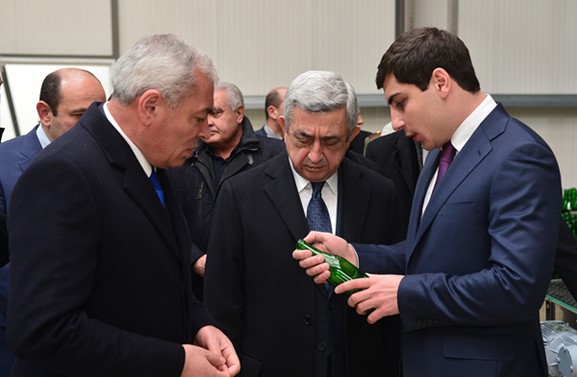
Ashot Arsenyan’s parliamentary career and the most successful period in the development of his business coincided with the years of Serzh Sargsyan’s presidency. During this period, the Armenian press repeatedly linked his business success and political influence to his close relations with the country’s top leadership.
According to media reports, Serzh Sargsyan, as well as Hovik Abrahamyan, regularly spent part of their vacations in Jermuk and at properties belonging to Arsenyan, including his mansion in Baden-Baden, Germany. These publications viewed the trusted relationship between the president and the businessman as one of the factors strengthening Arsenyan’s position in politics and business.
In September 2015, Serzh Sargsyan awarded Ashot Arsenyan the 2nd Degree Medal “For Services to the Homeland.”
It is noteworthy that just three years later, many representatives of big business and the political elite who had previously received state awards from the president, including Samvel Aleksanyan, Gurgen Arsenyan, and others, quickly distanced themselves from the country’s former leadership after the change of power and built relations with the new political team.
Ashot Arsenyan was among those who managed to successfully overcome the political transition. When Nikol Pashinyan was elected prime minister, he voted in his favor and almost completely stopped making public political statements.
As subsequent events showed, the change of power not only did not weaken the Arsenyan family’s positions, but also opened a new stage of political integration for it. Soon enough, family representatives occupied key positions within the Civil Contract system, while the influence of the business group was preserved.
After the Revolution: New Government, Former Model
The fact that the Arsenyan family’s relations with the new political team were not limited to declarations of loyalty is evidenced by subsequent events. After the change of power, companies connected to the family continued to receive state support, while representatives of the business began financing structures close to the ruling team.
Thus, on July 31, 2023, Vladimir Poghosyan, who at the time held the position of director of “Jermuk Group” CJSC, transferred 2.5 million drams to the ruling Civil Contract party as part of a party charity evening. A month and a half later, on September 14, 2023, the government exempted “Jermuk Group” from paying customs duties amounting to 102.6 million drams during the import of raw materials and equipment with a total value of 8.3 billion drams.
The proximity of these events in itself does not indicate the existence of any arrangement between the company and the state. Nevertheless, the sequence of events, in which a donation made in favor of the ruling party preceded the granting of a major state privilege to the family business, inevitably raises questions about the nature of the Arsenyan family’s relations with the new political system.
Financial support also extended to the “My Step” Foundation headed by Anna Hakobyan, the prime minister’s wife. According to published data, in 2024–2025, “Jermuk Group” CJSC transferred 10 million drams to the foundation.
Thus, the 2018 change of power did not result in the Arsenyan family being pushed out of the established political-economic system. The political center of decision-making changed, but the model of relations itself remained recognizable: financial support for structures connected to the government in power, state privileges for the family business, and the preservation of the family’s political influence, now through representatives of the next generation.
The New Government’s Old Accusations
The 2018 change of power created expectations that the stories that had not received a legal assessment under the previous leadership would be reconsidered. Among those who hoped to benefit from the new political situation was Russian-based Armenian businessman Murad Muradyan. For more than twenty years, he had publicly accused Ashot Arsenyan of appropriating the business and organizing criminal prosecution against his partners.
On July 26, 2018, during a meeting between Prime Minister Nikol Pashinyan and representatives of the Armenian community in St. Petersburg, Muradyan once again presented the history of the conflict, the beginning of which, according to him, dates back to 1996. At that time, the businessman claims, he jointly founded “MAK” CJSC with Ashot Arsenyan and Koryun Hakobyan, with each owning 33% of the shares.
According to Muradyan’s version, after he and Koryun Hakobyan were involved in a car accident in St. Petersburg and spent more than a month receiving medical treatment, Ashot Arsenyan dismantled the water pipeline belonging to “MAK” CJSC and illegally sold it. In addition, Muradyan claimed that Arsenyan sold his wife the 25 “KamAZ” trucks and heavy machinery belonging to the “Jermuk Shin” trust for only USD 5,000. Meanwhile, according to Muradyan, at that time the value of one “KamAZ” vehicle exceeded USD 10,000.
Muradyan claimed that after returning to Armenia, he and Koryun Hakobyan spent about four and a half months unsuccessfully trying to recover the property. According to him, it was based on Arsenyan’s complaint that Koryun Hakobyan was subjected to criminal prosecution and subsequently sentenced to eight years in prison, while Muradyan himself left Armenia and was placed on the wanted list.
During the meeting with the prime minister, Muradyan also stated that an assassination attempt had been made against him in 2003, and he publicly placed responsibility for organizing it on Ashot Arsenyan.
In response, Nikol Pashinyan stated that he would instruct that the circumstances presented be checked and emphasized that in the new Armenia, criminal prosecution should not be used for political motives.
Almost immediately, Ashot Arsenyan issued an official statement, in which he completely denied all the accusations. He called Muradyan’s claims absurd and defamatory, aimed at discrediting his business reputation, and described Muradyan himself as a person with a criminal past who had repeatedly been involved in various criminal stories.
The public confrontation did not lead to further procedural developments. According to available data, Muradyan’s statements did not result in a criminal case being initiated against Ashot Arsenyan, while the conflict gradually disappeared from the public agenda, remaining limited to mutual accusations by the parties.