
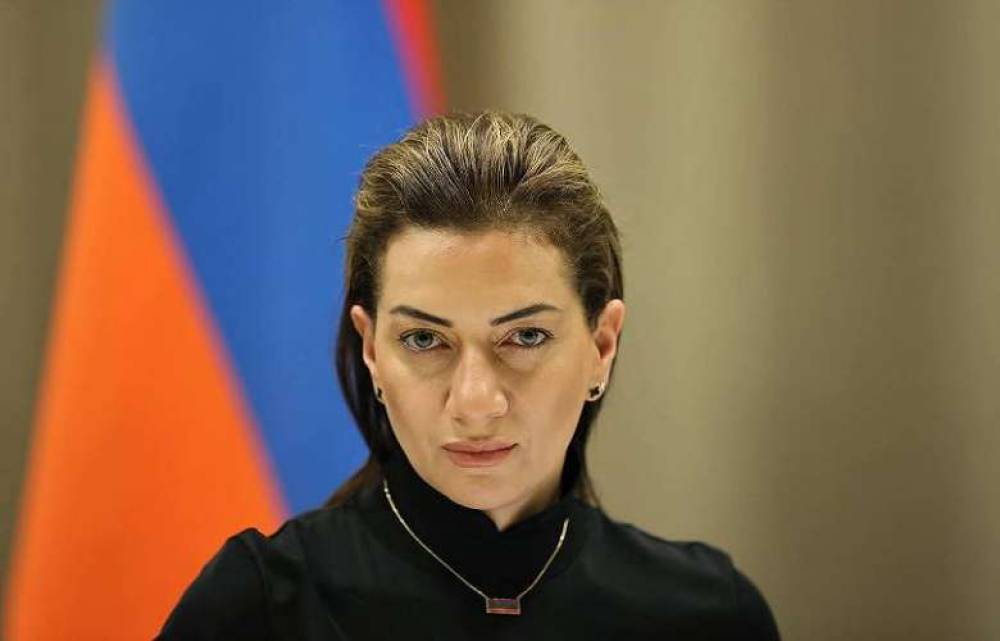
ANNA HAKOBYAN: PASHINYAN’S LIGHTNING ROD
This ANI investigation concerns the activities of Anna Hakobyan, a figure who is officially devoid of state status, yet for years has demonstrated a stable and multilayered influence on the political, financial, and social processes of the Republic of Armenia.
Within the framework of the analysis conducted, a systemic contradiction is recorded between the absence of an institutional mandate and actual participation in processes bearing the characteristics of state significance. This model is expressed through the stable reproduction of practices of influence without formal responsibility, which in itself creates a legal and administrative anomaly.
Informal Status as a Tool of Influence
Since 2018, Anna Hakobyan, while holding no state office, has in practice performed functions comparable to those of a first lady, including participation in international visits, public diplomacy, and domestic political communication. At the same time, her activities unfolded outside the framework of legal regulation, which excludes mechanisms of accountability and oversight.
This structure made it possible to form a unique model: a presence in the decision-making system without legally established responsibility for the consequences of those decisions.
Military Context: The Limits of What Is Permissible
The investigation pays particular attention to the period of the 44-day war. Conflicting information has been recorded in the public domain regarding Anna Hakobyan’s presence near or directly inside command posts.
On the one hand, these facts have been denied by a number of participants in the events. On the other hand, there are direct testimonies from a high-ranking military officer regarding her presence in an area where access is restricted and regulated.
Even the hypothetical confirmation of this episode would mean a violation of the fundamental principle of separation between the civilian and military spheres, which, under conditions of military operations, takes on the nature of a potential threat to governability and security.
The “Erato” Project: Statements and Actual Circumstances
The creation of the “Erato” volunteer detachment was accompanied by public rhetoric about direct participation in military operations. However, testimonies point to the absence of confirmed facts of the unit’s presence on the front line.
The following circumstances were additionally established:
· Lack of a transparent procedure for selecting participants,
· Actual disregard for basic background checks,
· Inconsistency between the stated objectives and the detachment’s actual deployment.
Thus, the “Erato” project acquires the characteristics of an informational-propaganda structure that is not substantiated by a comparable level of actual participation.
Financial Activity: Non-Transparent Features
The “My Step” Foundation, headed by Anna Hakobyan, demonstrates a financial model containing a number of systemic risks:
- a significant share of anonymous donations (up to one-third of all inflows),
- sharp fluctuations in the volume of funding without an economically justified rationale,
- participation of donors who are involved in judicial and corruption-related episodes,
- closed nature of fundraising events.
The structure of expenditures also deserves additional attention, including incompletely implemented projects and the absence of public accountability in key areas.
From a legal perspective, such a financing model, under conditions of a lack of transparency, may create preconditions for abuses, including the possible use of the foundation as a tool of indirect influence or redistribution of resources.
Declarations and Property Dynamics
Analysis of official declarations reveals a sharp financial jump recorded in 2024, expressed in a multiple increase in income and the emergence of significant assets.
The nature of this change — being one-time and disproportionate to the previous dynamics — requires an additional legal assessment from the perspective of the sources of origin of the funds and compliance with anti-corruption standards.
Network of Connections: Institutional Laundering
A separate section of the investigation concerns the circle of people who maintain stable personal and professional relationships with Hakobyan. In a number of cases, the intersection of these connections with appointments to state or quasi-state positions is recorded.
In different fields — the prosecutor’s office, the judicial system, education, and the media — a recurring pattern is recorded: personal closeness to Anna Hakobyan coincides with institutional advancement.
Each individual case may in itself be explainable, but their aggregate forms a trend. And a trend is no longer a coincidence.
Public Rhetoric as a Destabilizing Factor
High-profile statements, including unverified information about mass desertion, as well as public assessments directed at state officials, attest to a discrepancy between the level of responsibility and the scale of the consequences.
In a post-conflict society, such rhetoric may be viewed as a factor undermining trust in state institutions.
Final Assessment
The aggregate of established facts allows us to speak of the formation of a stable model, namely:
· Influence without office,
· Participation in political processes without a mandate,
· Resources without transparency,
· Connections without formal responsibility.
This model is neither accidental nor episodic in nature. It is reproduced across different spheres, from the military to the financial, and is accompanied by a systemic absence of oversight mechanisms.
From a legal and institutional perspective, this is a phenomenon of an unformalized center of influence operating in parallel with official structures.