
HayPost’s billions, unresolved irregularities and political favouritism in executive appointments: who will Answer for it?

Violations worth 4.1 billion drams, a terminated criminal investigation, billions of drams in allocations from the state budget, the transfer of property at 22 Saryan Street to an investment company, and a monthly salary of more than 3.6 million drams for the head of the state postal operator. These facts surrounding Haypost reveal a system in which there are many questions about the management of public funds, but very few answers.
In 2023, the State Supervision Service announced that its examination of Haypost’s activities from 2017 to 2021 had identified violations worth approximately 4.1 billion drams. The materials were sent to the Prosecutor General’s Office, and criminal proceedings were initiated, but they were terminated on November 29, 2024. To this day, the published information does not reveal which of the recorded incidents were fully disproven, how much money was returned, or what obligations remain with the company.
Meanwhile, the company continues to operate under state ownership, conduct major transactions, and receive additional funding from the state budget. Against this backdrop, the authorities have not presented the public with a complete accounting of the financial consequences of the earlier violations.
Violations Worth 4.1 Billion Drams: The Proceedings Were Terminated, but the Accounting Was Not Completed
According to the State Supervision Service’s official statement of May 17, 2023, the examination covered Haypost’s revenues and expenses, accounts receivable, use of property, leases, construction work, and procurement. The Service reported that the company had operated profitably from 2017 to 2019 but had recorded financial losses in 2020 and 2021.
The list of incidents identified during the examination was striking. The company had purchased the Riposte software system for approximately $1.7 million, which, according to the State Supervision Service, had never been used. Approximately 410 million drams had been calculated for its depreciation, and a further 446 million drams had been paid as compensation to the trust manager. The Service estimated the total damage from this transaction at approximately 1.4 billion drams.
Regarding outstanding obligations to the state budget, approximately 724 million drams had been recorded in unpaid dividends and penalties on them. The supply of postage stamps to its US-registered subsidiary, Haypost USA Corp., had resulted in accounts receivable of approximately 758 million drams. Due to the undercalculation of profits, a further 55 million drams in corporate income tax had not been paid to the budget.
The State Supervision Service also recorded at least 82 million drams in unrealized revenue and approximately 125 million drams in losses resulting from lease agreements; violations worth around 25 million drams in construction work; approximately 24 million drams withheld from employees because of an error in the Phoenix software; 17 million drams in expenses charged without supporting documents; and violations worth around 15 million drams related to salaries paid to employees who had been unjustifiably absent abroad. A further approximately 448 million drams in violations concerned loans provided to the subsidiary, penalties related to dismissals, and other expenses.
According to the official statement, while the company’s net assets were declining, its executive director received approximately 39 million drams in bonuses and 16 million drams in compensation upon dismissal within one year. This was despite the fact that the director’s employment contract stipulated an obligation to prevent a decline in the company’s net assets.
On October 22, 2026, Factor.am published responses from the Investigative Committee and the State Supervision Service. The Investigative Committee stated that some incidents had been disproven during the preliminary investigation, while decisions had been made not to pursue criminal prosecution in other cases. However, the specific incidents were not disclosed. The State Supervision Service reported that some of the money had been returned and that court proceedings were underway concerning certain claims, but it did not provide the total amount recovered.
The most interesting circumstance is that the State Supervision Service did not appeal the decision to terminate the criminal proceedings. As a result, the most important questions for public oversight remain unanswered. The dismissal of certain allegations does not reveal the fate of the others, and information that some money has been returned is no substitute for a full accounting: how much has been recovered, what is still being claimed, and what has definitively fallen beyond the possibility of recovery.
State Money Caught Between Debt, Loans, and Capital Increases
It is impossible to discuss Haypost’s financial condition without addressing the scale of state support it has received.
In 2024, the government increased the company’s charter capital by approximately 1.95 billion drams. In 2025, it provided a further budget loan of 866.5 million drams at an annual interest rate of 7.66 percent to settle corporate income tax obligations. The ministry told Factor.am that the entire amount covered by the loan had been paid into the state budget by the end of 2025.
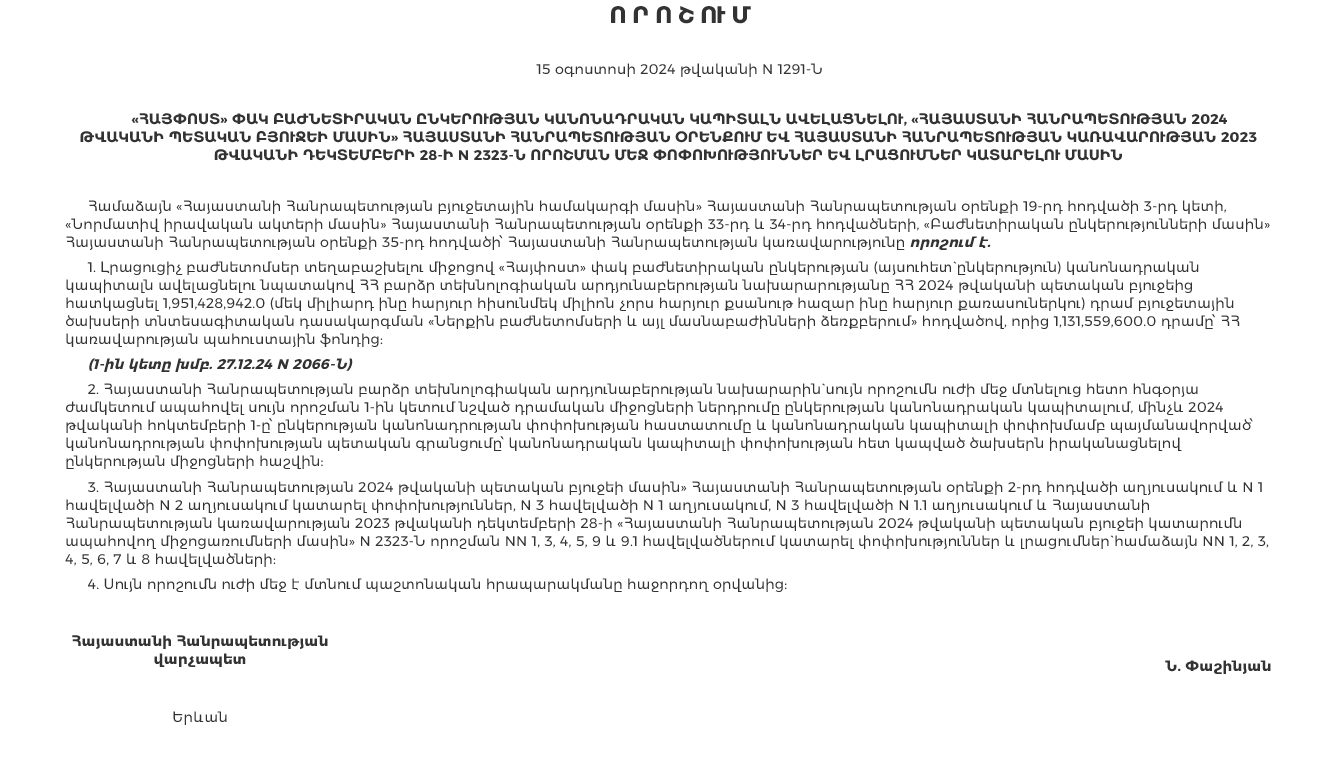
The total amount of the two allocations is approximately 2.82 billion drams. A capital increase and a loan are different financial instruments, but both require public accountability. The state must explain why the company’s capital needed to be increased, what results the investment produced, and why an additional loan was required to settle tax obligations.
It is particularly noteworthy that Haypost’s consolidated financial statements recorded a loss of 523.2 million drams in 2025. Depreciation, amortization, and impairment expenses amounted to approximately 932.6 million drams. The company’s revenue and gross profit declined, while its operating activities continued to produce a negative result.
Haypost’s management later presented a different emphasis, arguing that its EBITDA for 2025 was positive and that the negative result of approximately 500 million drams was attributable to depreciation and amortization charges. However, positive EBITDA does not eliminate questions about the loss, declining revenue, and growing loan obligations. The company’s financial condition must be assessed on the basis of complete financial statements, cash flows, and changes in liabilities.
Haypost’s Director: A Salary of More Than 3.6 Million Drams

Questions about Haypost’s management become even more concerning when the company’s financial results are considered alongside executive compensation.
In a publication dated July 31, 2026, Azatutyun reported that Shushan Aleksanyan, the wife of Hayk Konjoryan, head of the Civil Contract parliamentary faction, had been appointed Haypost’s chief executive officer in November 2024. According to the declaration she submitted to the Corruption Prevention Commission, her annual salary exceeds $118,000, equivalent to more than 3.6 million drams per month.
Azatutyun had submitted a written request to Haypost and the Ministry of High-Tech Industry seeking the records of the director’s appointment competition, information about the participants, and the composition of the supervisory board. However, it received no answers to these questions. The company classified information about supervisory board members as personal data, while the ministry refused to provide the minutes of shareholders’ meeting decisions, citing commercial secrecy.
The ministry also stated that there was no separate formula, set of criteria, or special principles for determining the salary of Haypost’s chief executive officer. At the same time, the same ministry refused to provide information about the director’s salary over the previous six years and changes to it.
This raises a direct issue of management transparency. The procedure for selecting the head of a state-owned company, the basis for determining their salary, and decisions concerning the management of state property are matters subject to public oversight. State bodies have no right to refuse to disclose these documents.
According to Azatutyun, Shushan Aleksanyan’s deputies are Arman Abrahamyan and Artak Ghulyan, but information about their compensation was also unavailable. Meanwhile, Haypost’s 2025 financial report shows that the salary fund for senior management increased from 176.7 million drams in 2024 to 227.2 million drams in 2025, a rise of more than 28 percent.
According to the same report, the company’s revenue declined by approximately 7 percent, from 9.8 billion drams to 9.1 billion drams. Gross profit fell from 1.475 billion drams to 1.027 billion drams. The taxes paid by the company in 2025 amounted to 3.4 billion drams, more than 300 million drams less than the previous year.
Loan obligations also increased. Compared with 58 million drams in 2024, they reached 396 million drams in 2025, approximately six times as much. Of this amount, 200 million drams consisted of bank loans, while 196 million drams represented financial lease obligations.
These figures require clarification. The company’s revenue is declining, its loan obligations are growing, and the salary fund for senior management is increasing. On the basis of what results were salaries raised? What criteria are used to evaluate the director’s performance, and why are these criteria kept secret?
The company’s management has argued that its EBITDA for 2025—the result calculated before interest, taxes, depreciation, and amortization—was positive, and that depreciation and amortization expenses had a significant impact on the loss. Shushan Aleksanyan has also stated that during her tenure the company paid approximately one billion drams in dividends, and that the period since her appointment has not been long enough to attribute previously accumulated problems to her.
These explanations must be considered alongside the complete financial statements. Depreciation is indeed not an immediate cash expense, but that does not eliminate the decline in revenue and gross profit, the growth in loan obligations, or the negative operating result. The performance of a state-owned company’s director must be assessed on the basis of measurable results. Those results must be available to the public.
The Building at 22 Saryan Street: State Property Whose Stake Is Gradually Being Sold Off
Another major component of Haypost’s financial history is the contribution of the postal building at 22 Saryan Street to the capital of World Trade Center Yerevan CJSC (World Trade Company).
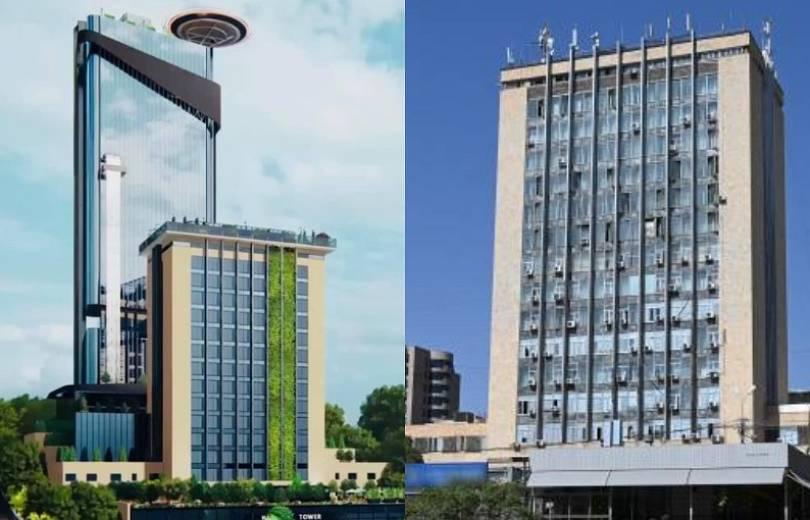
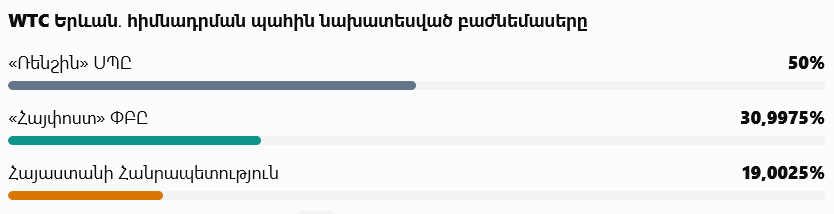
On September 7, 2023, the government approved the program submitted by Renshin LLC to construct a World Trade Center through Decision No. 1529-A. According to the decision, the new company’s charter capital was set at 21.89852 billion drams. Renshin was to contribute 10.94926 billion drams, the Republic of Armenia was to contribute real estate valued at 4.16126 billion drams, and Haypost was to contribute property valued at 6.788 billion drams.
Under the terms approved by the government, the investor was required to purchase Haypost’s shares within five years at the nominal price set when the company was established. The sale was planned in five stages, with shares worth 1.3576 billion drams to be transferred at each stage. The total amount for all five stages exactly matches the appraised value of the property contributed by Haypost: 6.788 billion drams. According to Factor.am, the share price was fixed in advance, with no mechanism for reassessment based on changes in market value or inflation.
The first-stage transaction took place in 2025. According to the financial statement data presented by Factor.am, Haypost received 1.3576 billion drams from the sale of shares, while its stake in WTC Yerevan declined from 30.997529 percent to 24.798023 percent.
In other words, the state-owned company has begun selling off its stake at a predetermined price. If the value of the property or the company’s economic value increases during construction, the fixed price could deprive Haypost of the opportunity to benefit from that increase. This is a real economic risk, and determining its scale requires the publication of property appraisal reports, the shareholders’ agreement, and the project’s financial calculations.
It is noteworthy that contributing the property at 22 Saryan Street to the capital of World Trade Center Yerevan CJSC created an additional financial burden for Haypost. In 2024, the government allocated 1 billion 951.4 million drams from the state budget to increase the company’s charter capital.
According to a CivilNet investigation, as part of the transaction, Haypost was required to pay approximately 819.9 million drams for the cadastral value of the land plot and around 1.131 billion drams in value-added tax. According to the justification for the government decision, the company had been unable to fulfill these obligations fully and on time because of a lack of funds.
The issue did not end with this allocation. Under Decision No. 445-N of April 17, 2025, the government provided Haypost with another budget loan of 866,493,700 drams at an annual interest rate of 7.66 percent to settle corporate income tax obligations. According to Factor.am’s investigation, this obligation also included approximately 866.5 million drams in corporate income tax calculated as a result of contributing the property at 22 Saryan Street to the capital of the World Trade Center.
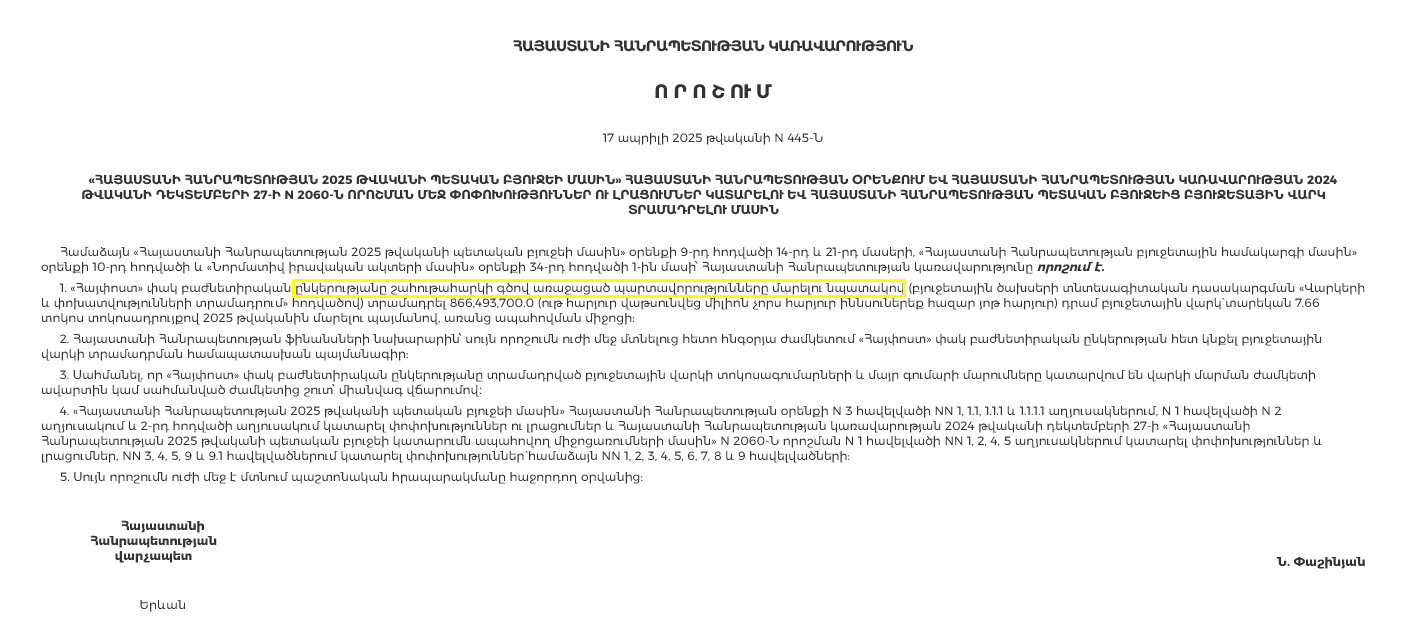
These facts raise specific questions. Why did the state-owned company, after contributing property valued at billions of drams to a major development project, lack sufficient funds to meet the related obligations from its own resources? How was the economic benefit of the transaction calculated, and why were its financial consequences covered through a capital increase from the state budget and a loan that must be repaid with interest? The government must publish the relevant financial calculations and explain what benefit the state has received and expects to receive from this transaction.
Who Will Be Held Accountable?
Thus, the State Supervision Service recorded violations worth 4.1 billion drams at Haypost, but the criminal proceedings were terminated, and the public still has no complete accounting of how much money was returned or whether anyone was held accountable. The State Supervision Service did not even appeal the decision to terminate the proceedings.
Instead, the state provided Haypost with new support amounting to approximately 2.82 billion drams. The company’s revenue declined, its loan obligations increased, and the salary fund for senior management grew by more than 28 percent in a single year. The records of the director’s appointment competition and the criteria used to determine the salary have not been made available to the public.
This is the picture of state governance: billions in violations, new allocations, and closed documents. The authorities are obliged to publish a complete accounting of the consequences of the violations, explain the terms of the property transaction at 22 Saryan Street, and answer the central question: who is responsible for these outcomes in the management of public money and state property?