
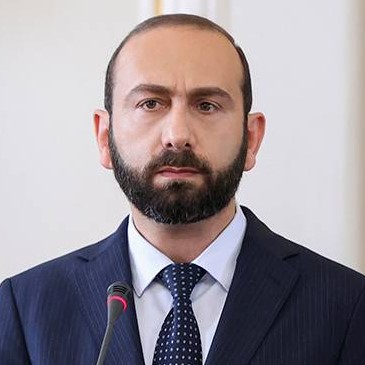
“THE CLASSIC TRAITOR”: ARARAT MIRZOYAN — FROM “OMEGA” TO TRIPP
Ararat Mirzoyan, Minister of Foreign Affairs of the Republic of Armenia and a member of the ruling Civil Contract party, is a figure around whom a system of revelations and public deception is built. Turkish media outlets refer to him as “Arabat,” which is not accidental: a man who has betrayed the historical memory of the Armenian people by turning the Armenian Genocide into “an insignificant issue of the future” becomes a convenient object of external control.
The facts themselves point to a clear chain of actions: state institutions consciously remove the most sensitive areas from public oversight — the special services, historical memory, archives, and strategic communications. The fact of Ararat Mirzoyan’s cooperation with the National Security Service was acknowledged by Mirzoyan himself: the “Omega” document, which recorded these interactions, has still not received a legal assessment.
The disappearance of 19,000 rare and valuable books from the collections of the Armenian Genocide Museum-Institute remains uninvestigated to this day. There are no defendants, the case has been dragging on for years, and the questions are being ignored. Public statements by former museum director Hayk Demoyan, as well as inquiries and appeals by deputies to the Investigative Committee of the Republic of Armenia, have remained unanswered.
An involuntary impression emerges that the state is simply turning a blind eye to prolonged inaction, encouraging the minister to create a “family project”: Ararat Mirzoyan is shaping the political and legal framework for projects such as TRIPP and the “Crossroads of Peace,” while his wife, Gohar Abajyan, is turning it into an investment product through Enterprise Armenia.
As a result, a system of conflicts of interest emerges in which legality becomes merely formal. In practice, state decisions are concentrated in the hands of the married couple, while there is no independent public oversight over these matters. Strategic initiatives, including international projects and regional communications, are effectively removed from public scrutiny.
The actions of Ararat Mirzoyan and Gohar Abajyan coincide in terms of timing and direction: the Ministry of Foreign Affairs establishes the legal and diplomatic framework for the projects, while Enterprise Armenia turns it into investment solutions. Sovereignty and regional stability are used as arguments for attracting investment. There are no formal violations of the law, yet the structure creates a significant systemic risk: concentrating functions within one family reduces public oversight, limits transparency, and turns strategic decisions into a closed management tool.
Here is the broader context: Ararat Mirzoyan’s professional path begins with work in archives, with the memory of the Genocide and the National Archives, and later develops into involvement in international programs and financial institutions such as HSBC and IFES. This career path is then transformed into an activity that pushes historical memory out of the framework of national priorities. Add to this the absence of judicial proceedings in the case of the missing books, the chronic silence of state institutions, and, in parallel, his wife’s activity in the investment and regional spheres.
And the main question facing Armenia today is this: can a man who, in essence, has betrayed the memory of the one and a half million victims of the Armenian Genocide and historical memory, worked for the interests of foreign banks and intelligence services, manipulated revolutionary processes, and left key national security issues unanswered, truly lead the state toward a bright future? Or, on the contrary, are the activities of “Arabat” and his wife Gohar already placing the country’s territorial integrity and sovereignty at risk, including strategically important regions such as Syunik?